

Indie tactical RPG Never's End promises dense systems-driven mechanics in a small package
One of the advantages of attending events like GDC is participating in the various indie game mixer-showcases that take place during or around the conference. Especially when game discovery can be difficult to come by otherwise, it's opportune and encouraging to meet with smaller developers eager to showcase their titles to attendees. One of the role-playing games I had the chance to check out was Never's End, a dense systems-driven tactical RPG with some procedural world elements.
During GDC, I had a chance to meet with Ryan Juckett, former Destiny lead sandbox designer and founder of the development team Hypersect. Never's End is a project he's been working on for nearly eight years, with a small team of full and part-time employees, alongside contractors. Some of the other key contributors to the project include character artist Masayoshi Nishimura (Triangle Strategy, Octopath Traveler) and composer Doseone (Enter the Gungeon, Gang Beasts).
"Never's End sits in between Final Fantasy Tactics — like Square style, classic stuff — as well as something like Battle Brothers style game, if you're familiar with that," Juckett says as he introduces the game to me. "Unlike classic strategy RPGs, Battle Brothers is a bit more open-ended, more non-linear. There's a big world, it's very systems-heavy, and the combat is a lot more nuanced." It was clear that Juckett wanted to include many similar intricate tactical mechanics within Never's End.
Within just a few minutes of playing the Combat Demo, it is immediately evident that Never's End is chock full of numbers, properties, mechanics, and other crunchy RPG systems. Not only do characters have health bars, but so does every piece of equipment that they are wearing, including their armor, hat, and whatever weapon they are wielding. Icons and numbers are plentiful across the screen, indicating all sorts of information from unit status, weapon attack types, armor properties, resource meters, map elements, and more, probably.
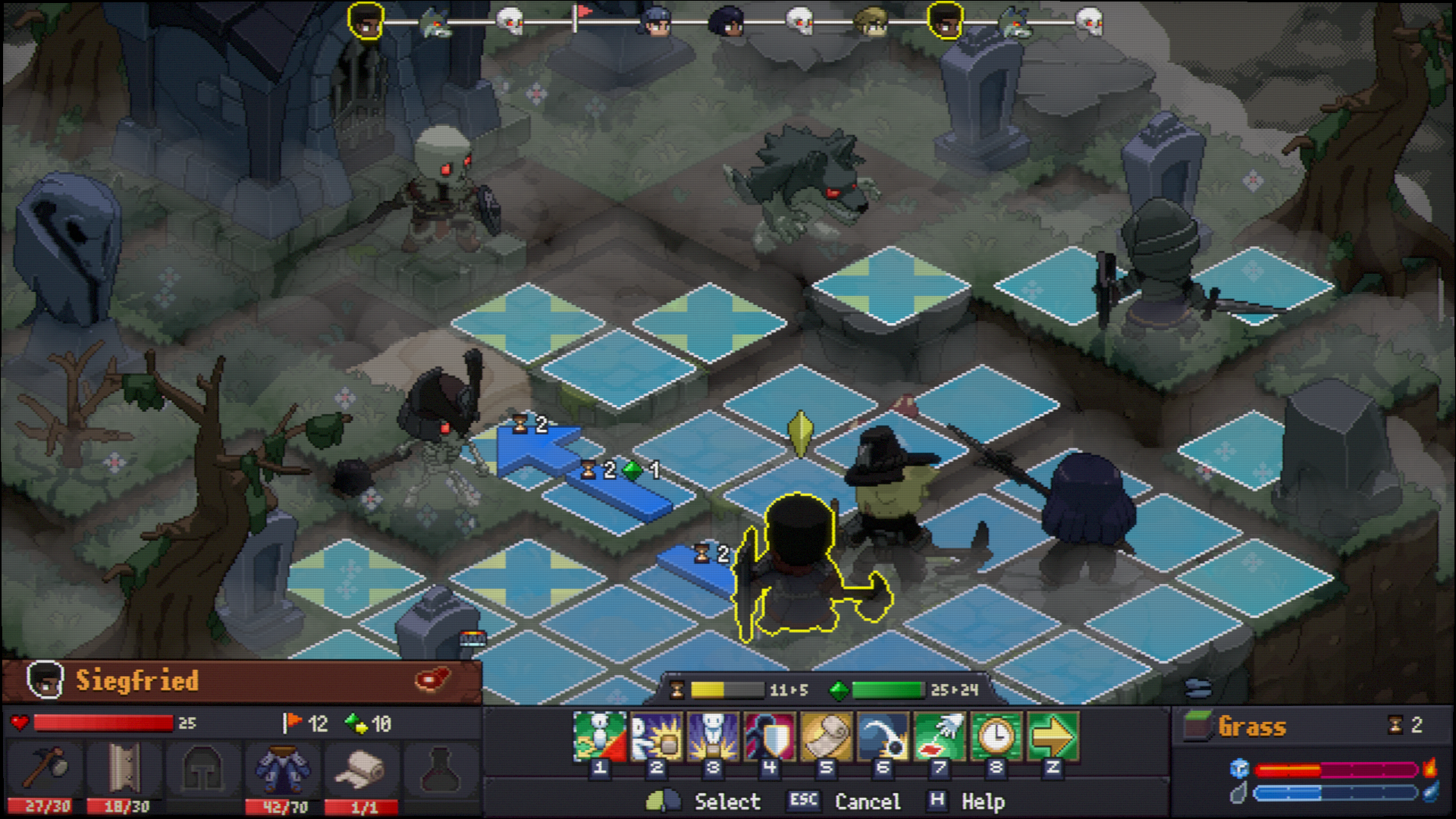
In battle, there is both a Time resource and a Stamina resource that you need to keep tabs on at all times. Time is something like a short-term action gauge that replenishes every turn. Stamina is more of a long-term resource that replenishes more slowly over the course of a battle. Both Time and Stamina are required to perform actions, so both short-term and long-term resource management are things you need to pay attention to and plan for as you proceed through the game's tactical battles.
Role-playing mechanics and sub-systems can be found all over Never's End. Right away in the Combat Demo, you'll have to pick your army participants from the pool of characters available at the local tavern. These characters all have varying characteristics. For example, a unit labeled as a 'Carpenter' will have higher Stamina recovery than other types of characters. A "Swift" characteristic raises their evasion. There are also characteristics like "Smart" that provide other sorts of benefits. Different weapon and equipment types all have different effects to keep in mind, including slashing, crushing, or piercing damage, as well as attack range, weight, and more.
All of these icons, symbols, and numbers can be admittedly a bit confusing at a glance. Luckily, Never's End has a persistent help feature available at any time to help you digest the plethora of information present on the screen. With the press of a button, the game will pause, allowing you to mouse over anything on screen to provide detailed tool-tips on what you are looking at.
"You can basically just turn on tip mode and move the cursor to any point and say, 'What is anything on the screen?'" Juckett explains. "Depth generally comes with a bit of complexity, but we also want to make it accessible and easy for people to just be like, I'm just going to pause what's on screen right here, and I'm gonna look at, like, what does that symbol mean?' You can pause the game, poke around the screen and see, this means this, that means that, right?"
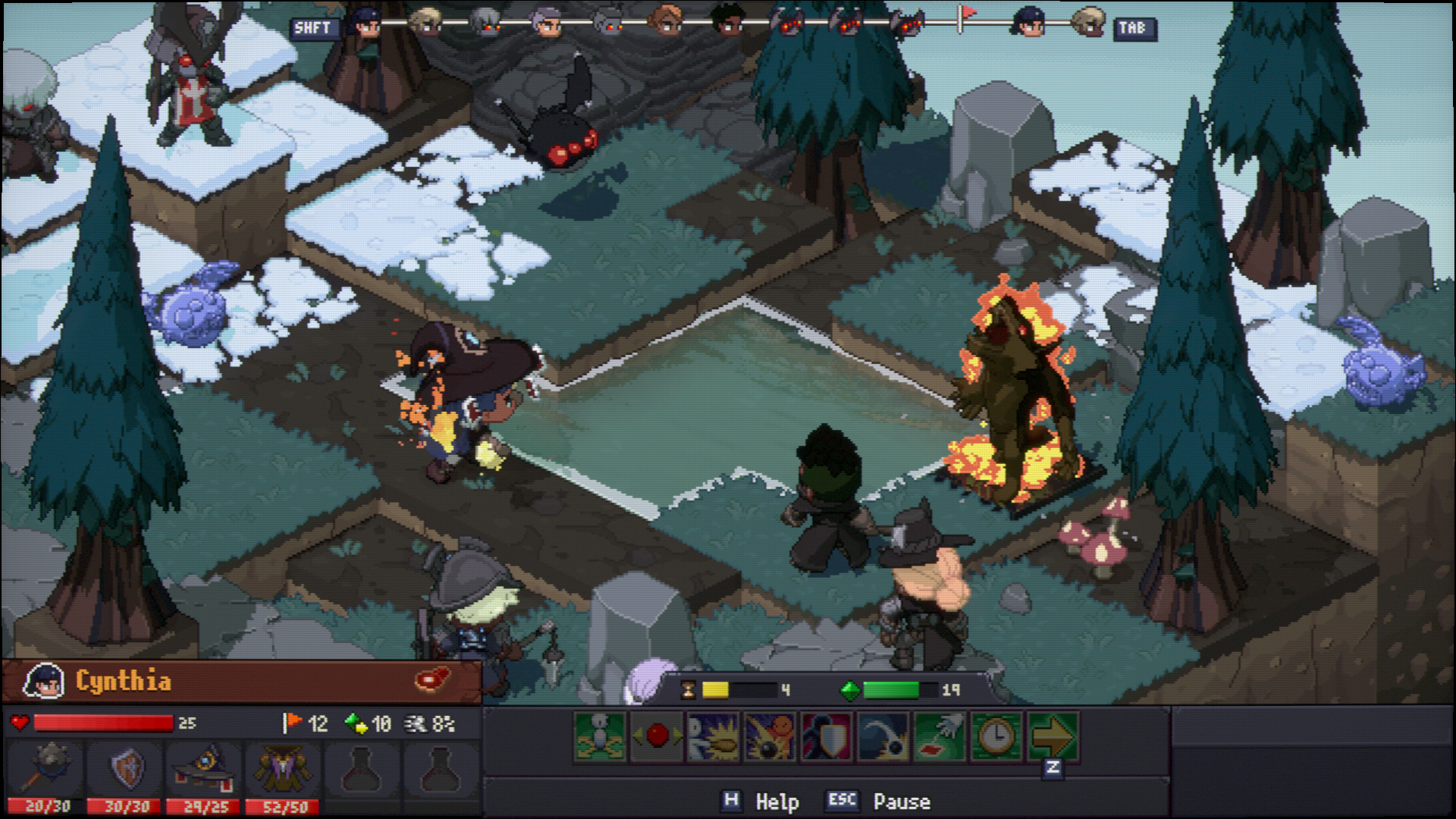
One of the more distinctive elements of Never's End is its magic system. Rather than simply being able to cast a fireball, ice spell, or a tornado, you can instead manipulate the temperature of the battlefield. The base temperature of any tile on the battlefield can be raised or lowered by your magic spells. By manipulating the temperature of various tiles, not only are you raising heat or causing cold, but you are also inevitably creating 'wind' effects that move from cold to hot based on the tiles you are messing with. Wind can be used in several ways, including moving enemies out of the way, into walls, or off of cliffs.
Wind can also have different effects based on what type of tile it is created on. Wind on top of a granite block will simply push a unit in the direction of the wind. A wind effect on a sand tile will also create a sand cloud on the tile, causing blindness to those who pass through the tile. Raise the temperature enough on a certain tile, and eventually it'll catch fire, causing burning damage to anyone on the tile. Lowering the temperature enough can cause varying ice/snow effects. Juckett explained to me that magic in this way is more of a tool that you have to learn how to use, rather than just selecting a target and firing off a spell. If you aren't careful, magic effects caused by your temperature manipulation can make things harder for you, so you'd better learn what you are doing, quickly.
There is also a humidity system in place that intersects with the weather system, causing effects like fog, which can affect accuracy. Some enemies will be strongly affected by heat, because it causes their actions to cost more Stamina. Some enemies, like bats, will go down quickly if they happen to catch fire. Some enemies, like skeletons, aren't really affected by temperature at all. However, they would still be affected by fog if they had to deal with it.
There are other considerations in battle as well. For example, walking through water can cause you to be 'wet', lowering your attack hit chance. As I played through the demo, fumbling around with all the various weapon types, Juckett chimed in with some advice.
"This is a great example of how all our weapons have their own little strategy," he says. "So this is a pickaxe, right? A pickaxe has two sides to it. There's a pick and the axe side, and that changes the damage type of the pickaxe. That makes it pretty versatile against different types of enemies. If you're fighting something, maybe they got a wooden shield, or maybe it's like a tree monster or something, those are more susceptible to a certain type of damage. But if you're fighting something with, like, metal armor or maybe like a spider, like you are here with the carapace, those are weak to the crushing damage. A pickaxe allows you to have the advantage against both types."
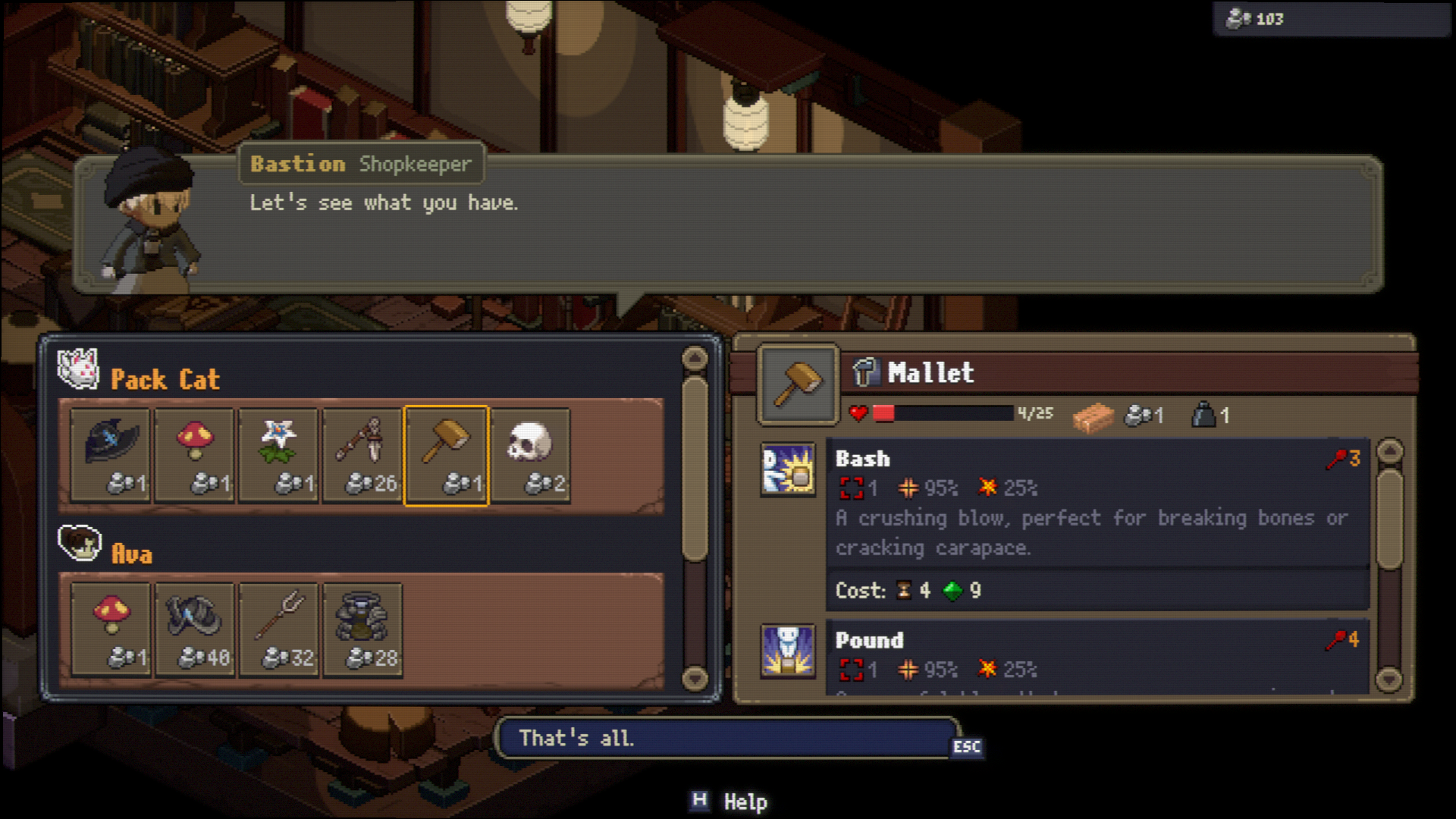
In my time with the demo, it was clear that damage types and damage resistances are crucial to finding success in Never's End. For example, leather armor is more resistant to blunt damage than it is to slashing damage or burn damage. Like any good tactical RPG, positioning is also an important consideration. Attacking at elevation gives you a higher chance of landing critical hit headshots. At one point, while I was playing, Juckett explained to me that if I set an enemy on fire, his wooden flail would also catch on fire, which can actually cause it to be more damaging. Flails are also less susceptible to shields, because the damaging end can swing around the guard. So, higher numbers aren't the only thing to pay attention to when choosing weapon types.
Using shields themselves have their own set of considerations to keep in mind. Shields don't just provide passive defenses for equipping them, they have to be actively used in battle, costing some Time and Stamina like any other action.
"You know, if you have a small buckler, you can raise it really cheap, but it offers less protection. If your shield's a bit heavier, it takes a little more time and energy to wield, but now your shield has a chance to block basically any incoming damage." Juckett proceeded to show me some of the in-game stats showcasing the math taking place behind the scenes, detailing both the damage being done and chances to hit, block, or dodge. "When there's like status effects or elevation, or other things affecting the outcome, for the person who really wants to get into the math, the game can show you the full breakdown and everything."
Juckett explained some of the other considerations in place when surveying the battlefield and choosing the equipment loadout you want to have in preparing for combat.
"So this saw weapon has tearing damage that's going to tear through cloth. So it'll be effective if someone has cloth body armor and a metal helmet, that saw is gonna do way better with body shots than head shots. Controlling attack percentages and damage chance is a big part of optimizing in the game. Tearing damage also has a special component where, if you're fighting something fleshy, it bleeds. Bleed stacks over time and causes persistent damage. So if somebody has exposed flesh, you can use a saw to get a few stacks of bleed in real quick."
As I started to grasp the different ways I could manipulate the game's mechanics to my will, I started to experiment with various strategies manifesting in my mind, including taking advantage of bleeding status and burn damage. Juckett cautioned me, however.
"If you do burn someone that's bleeding, it basically cauterizes and stops the bleed damage." Juckett says. Of course it does.
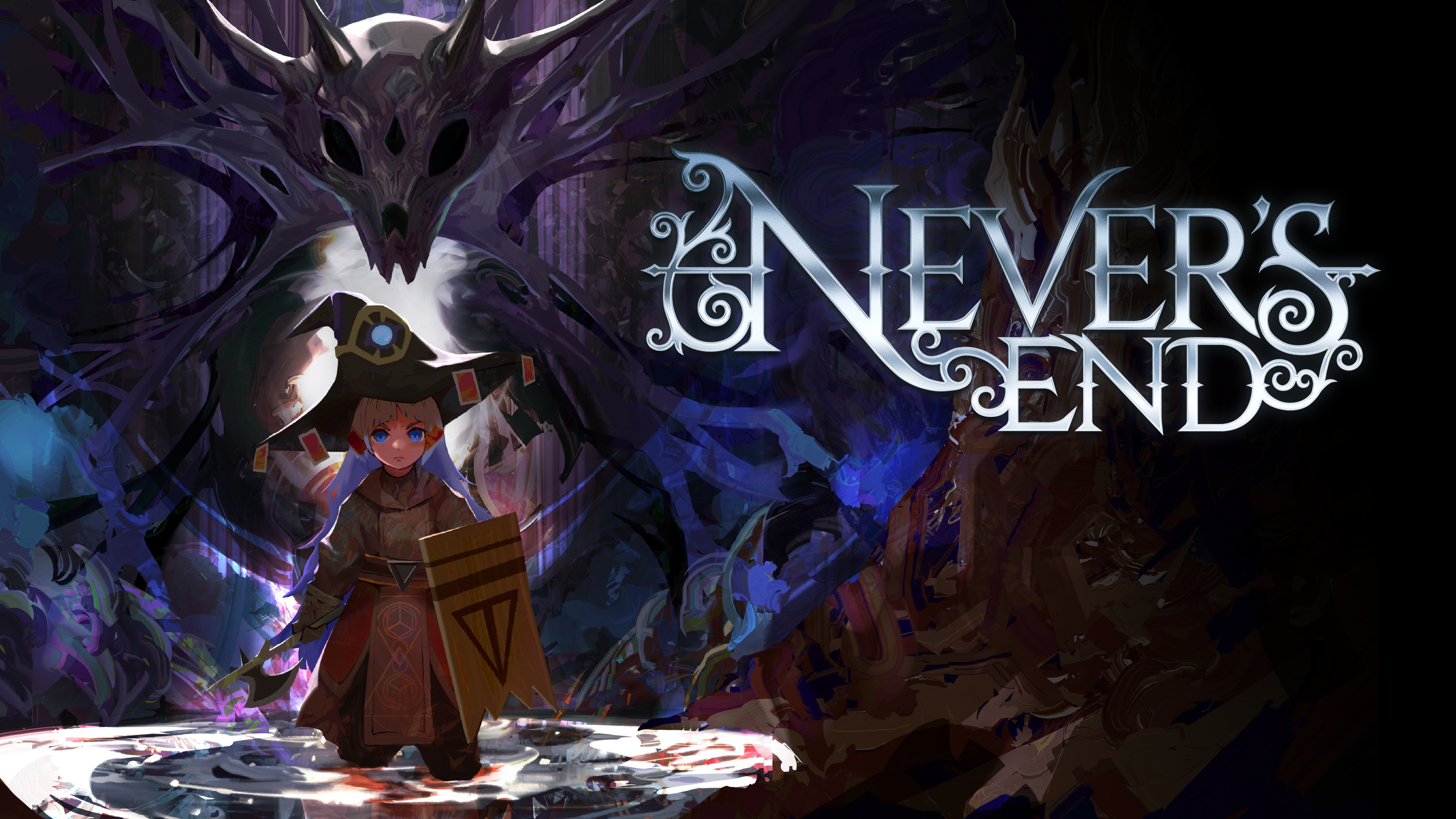
As I was wrapping up my demo session, I asked about the creative collaborators contributing to the game, including the game's art style, which is partially attributed to Masayoshi Nishimura.
"The concept art is by Masayoshi Nishimura. He's like a mix of a pixel artist and an illustrator, but he's done pixel art on a lot of games people have played, like Triangle Strategy and Octopath Traveler. For us, Masayoshi's done some character concepts, monster concepts, and a little bit of UI art. He actually doesn't do direct pixel art characters for us, because they're actually all 3D models. But his art has helped us build this authentic feel of a traditional classic JRPG-ish tactics game."
As the demo is specifically a Combat Demo, it's difficult to grasp the direction of the narrative or its prevalence from the gameplay experience alone. I asked Juckett if he could succinctly explain the game's story premise to me. He responded:
"So there's this force, this darkness called the Never, corrupting the world. When humanity gets close to the Never, they start going crazy, which has ultimately brought humanity to ruin. There's one island of safety left in the world as humanity is losing this conflict. Your character emerges mysteriously from it, and you are this being that was, sort of, created that can go out into the Never and fight back. Hopefully saving the world, basically."
I consider myself an RPG gearhead, so seeing all the interlocking systems in place in Never's End held my curiosity throughout my time with the demo. However, it is somewhat difficult to judge how the game's mechanics will work over time in a larger gameplay loop. There is a time passage system in place that affects the state of the world, as well as causes the corruption in the world to spread. You also have to pay your army salaries once per day.
Long-term progression is always a difficult component to judge in the narrow window of a demo, but I feel it is especially murky for a game like Never's End. The game has procedurally generated maps that will vary from person to person, ideally making it so each battle feel varied and dynamic. Will the game end up feeling repetitive over time, or will new elements come into play to make it feel varied the longer you play? Will corruption in the world make it feel like your progress stagnates even as you are clearing battles? We'll have to see as Never's End releases later this year.
Never's End is set to release in 2026 for PlayStation 5 and PC (Steam). The Combat Demo is currently available on the game's Steam page.