

"We Will Fearlessly Charge Forward, Trying Wild Crazy Ideas", how ArenaNet wants Guild Wars 3 to stand apart from other MMORPGs
Announced during Summer Game Fest earlier this summer, Guild Wars 3 is the newest entry in the long-running series from ArenaNet, and the first new game from the studio in over 14 years. As a very long-time Guild Wars fan who started with the series all the way back since the original release and a regular player since, needless to say, I was personally really excited but also a bit nervous, in a way. The gaming landscape of the late 2020's looks so much different now compared to that of 2012. How does a new MMORPG -- a designation in itself that many studios and publishers have seemingly strayed away from in recent years -- even fit into the gaming sphere of today?
In their announcement trailer, ArenaNet confidently declared Guild Wars 3 a "modern evolution of the MMO", and during Gamescom 2026 I had the opportunity to attend a virtual preview session with Game Director Colin Johanson and other members of the development team to see the first gameplay footage of the new title in action.
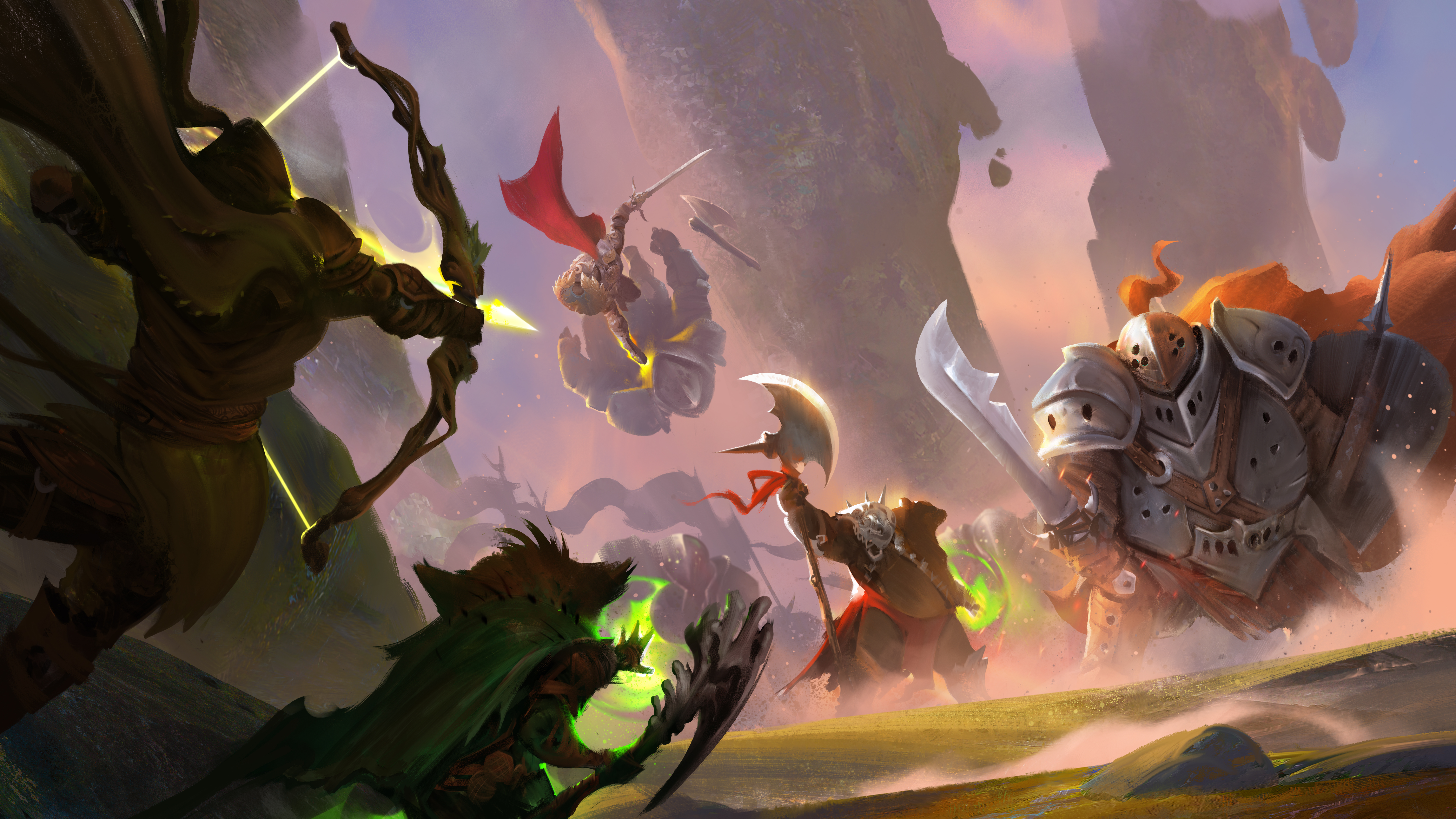
'Joy of Movement' and Momentum
At the very start of the preview session, one of two key aspects was immediately zeroed in on: Joy of Movement. In theme with this goal, in our session we got to see about 11 minutes of early alpha footage of the game, focused on exploration and combat gameplay. To clearly set the stage for what was shown, the footage was pre-recorded and depicted controller-based gameplay. No menu or other UI elements were shown other than a basic HUD and a small number of environmental tags like enemy health bars and nameplates -- so no build menu, map, social (guild/party), or inventory screens.
A segmented health bar was centered at the bottom of the screen, with three blue endurance pips above it. To the bottom right were three skill icons, mapped to the face buttons of a controller (ABXY mapping). A few other contextual icons were also located in the same area, including a few additional keybind icons mapped to the shoulder buttons. All other sections of the screen did not have any UI elements, and Colin reiterated that these visual elements were very likely to be refined later on. Even if placeholder, it was incredibly interesting to see a relatively clean UI after years of getting used to the interfaces of Guild Wars 1 and 2. Colin ended up spending time both during and after the gameplay preview describing how ArenaNet is taking an explicit focus to try to communicate the necessary gameplay information to the player while also pulling as much information 'out of the UI' as reasonable.
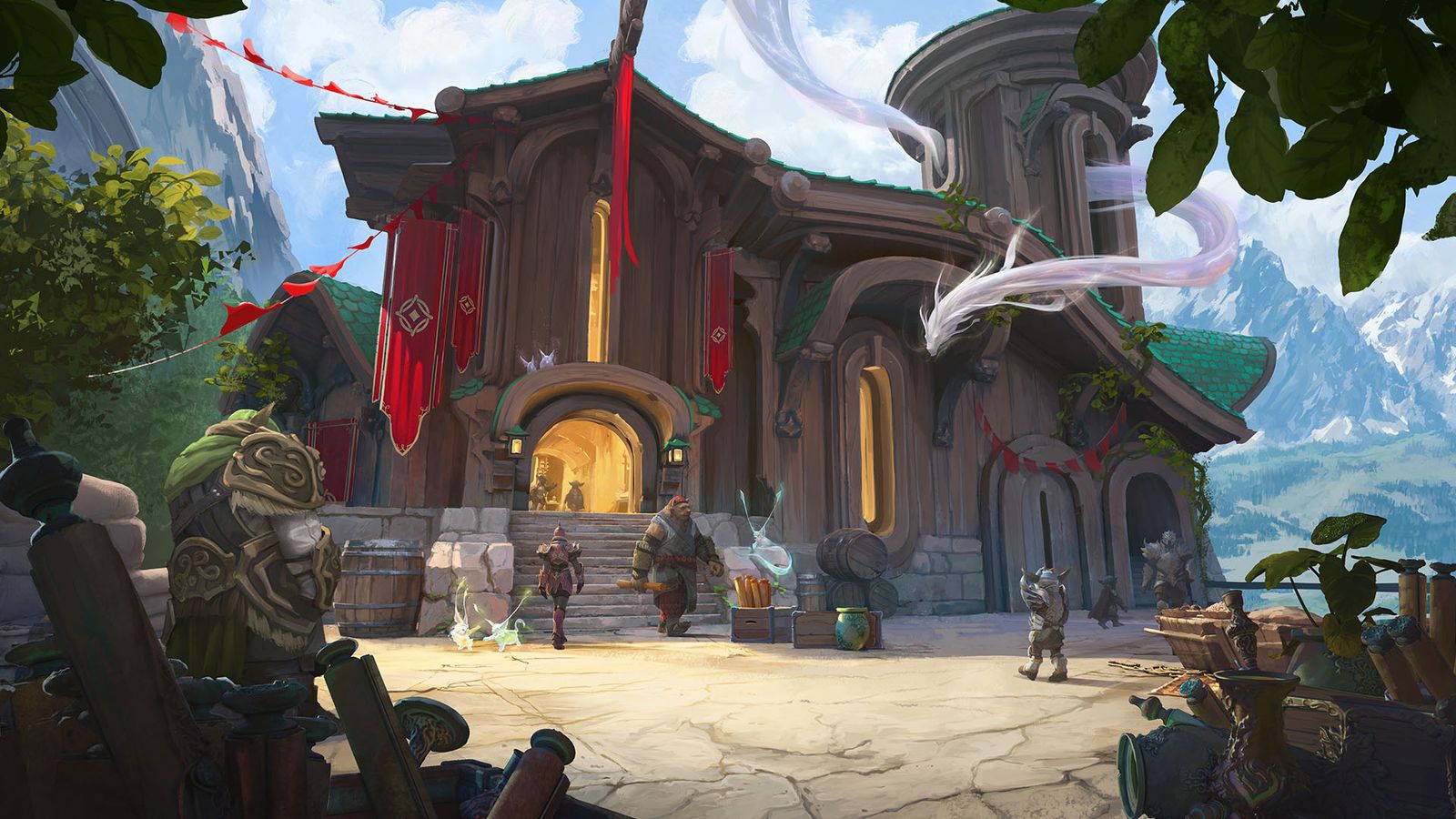
The gameplay was shown from the perspective of a Warrior wielding a sword and shield, with a Necromancer also joining partway through (in the later Q&A session, Colin also confirmed Ranger as a playable profession). The Warrior character immediately mantled over some environmental structures, including running up walls vertically as revealed in the initial trailer. From a higher vantage point, the city of Arah was shown in the distance. Known to Guild Wars 2 players as a drowned and decrepit city full of Risen corpses, the brief glimpse of Arah here was shown with a white/alabaster motif somewhat reminiscent of Amnytas, but it wasn't shown off. A nearby outpost of "Warden's Watch" was also shown as the starting point of the player's story. The environment itself was a verdant green grassland with some stone structures dotted around, and some interior temple environments were also shown later.
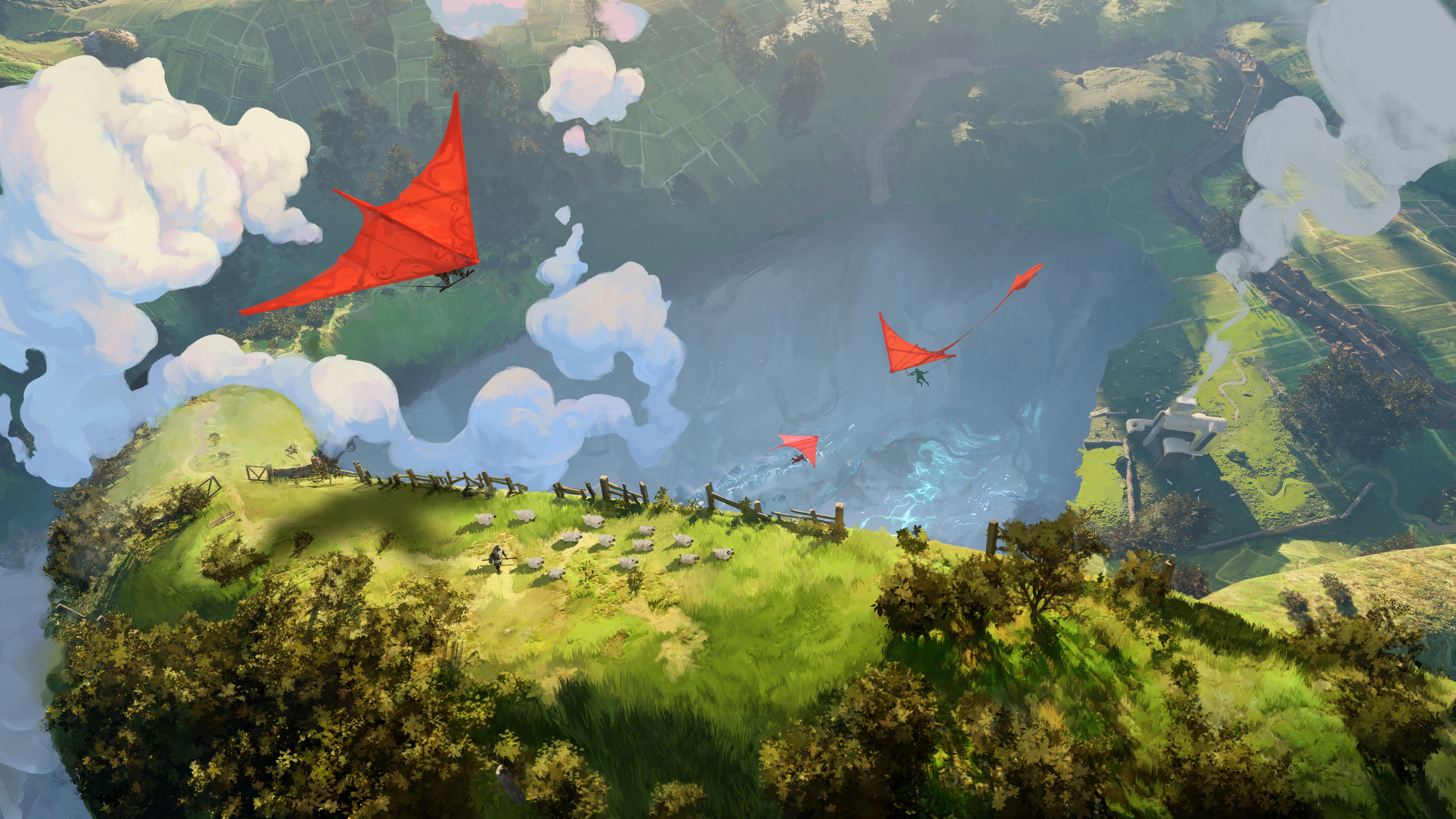
One of the initial movement skills we saw was that of Gliding. While very familiar to players of Guild Wars 2, the gliding here was shown as being "powered by momentum", with the character pitching their glider left and right as they descended from a higher vantage point. Colin emphasized that momentum is a fundamental component of the game, where the speed built up from one 'movement mode' will transition as players jump, glide, and then run up walls as a seamless transition. Key aspects of this were shown during the demo, with the player aiming their descending glider to a cliff face and then immediately mantling up it. After years of becoming accustomed to the gliding in Guild Wars 2, being able to bank and dive with the glider deployed almost seemed illegal.
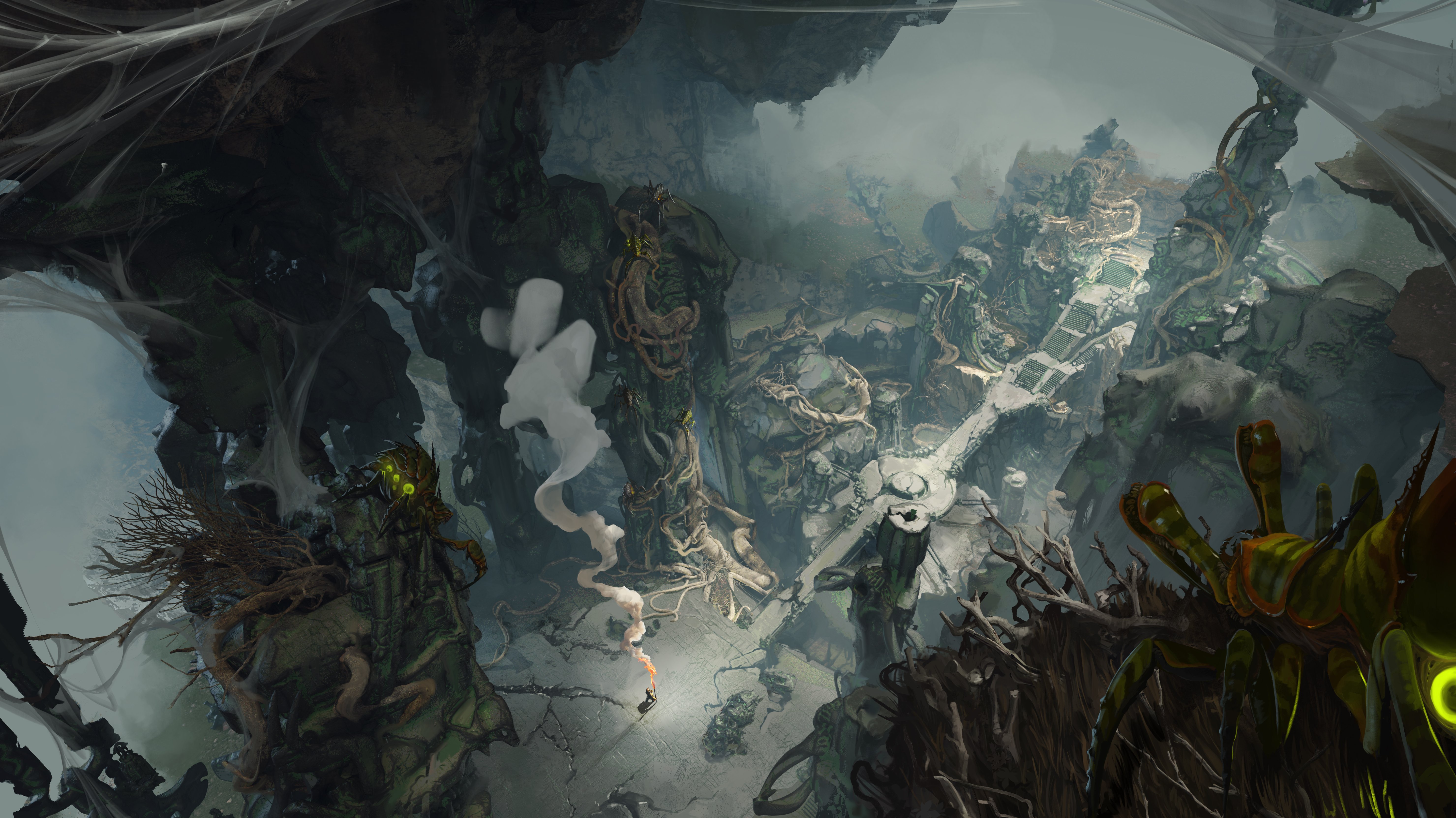
Combat, Multiplayer, and Customization
Beyond the 'Joy of Movement', the demo then went to connect this system to the second key focus of Guild Wars 3's gameplay, combat. The first combat encounter shown was against a pack of dinosaur-like raptors. The focus here was showing how player momentum is used in combat, with the two primary examples here being a sort of dive-bomb attack that could be used while airborne (from gliding, for instance) to impact enemies below the player on the ground, alongside a sort of Kick skill available to Warriors that 'Knock's nearby enemies away. For what it's worth, the other two player skill icons shown on the screen seemed to be a sort of upward launch of the player (presumably to provide altitude for more dive bomb attacks) and a skill that ignites nearby weapons on fire. The elite skill Rampage was also shown, described as allowing the warrior to knock around larger enemies that otherwise wouldn't be able to be moved around in that way.
The combat itself is tricky to describe, but the best point of reference to start would be the action-camera mode of Guild Wars 2. The player was centered in the middle of the screen with a white reticle just above them. There was no lock-on or tab target style interface shown in the gameplay preview, only the health bars below the enemy nameplates. Specific skills were shown impacting the enemy models, knocking them down or back and interrupting their attacks, while basic sword swings simply did a base level of damage.
In the second combat encounter, a scythe-wielding Necromancer joined the Warrior player. A previously abandoned temple to Dhuum (who at the time of Guild Wars 3 had only recently been overthrown by Grenth) was being inhabited by an enemy faction known as the Mavenwrights. This was used to demonstrate combo abilities, such as the Necromancer using the Warrior's shield like a springboard to gain height and momentum. This battlefield was also used to demonstrate using the terrain in combat encounters, such as knocking enemies off high places in order to quickly defeat them.
A 'burner' type veteran enemy was shown with a magical backpack weak point that the Warrior and Necromancer duo focused on to quickly dispatch the boss (who died once it exploded). During this section of the game, Colin went into some general details about how customizing a player build for specific enemies (such as spiders weak to fire) is a design element that the team has focused on, specifically calling back to Guild Wars 1 style buildcraft. In the later Q&A section of the preview, Colin said that while specific details are still being decided, certain areas of gameplay will have more freedom than others for changing these sorts of attributes 'on the fly', such as open-world type areas having fewer restrictions than something like dungeons. In the spider example, the Warrior's fire skill could be used to counterplay the spider webs that would otherwise slow the player down. This skill also ignited the weapon of the allied Necromancer as well, as an example of group synergy.
One other thing that was discussed briefly was the deliberate focus on having "less UI" on the screen. Colin emphasized trying to communicate combat state without having to rely on too many tooltips, such as enemies being frozen into a block of ice if enough players stack cold-attribute conditions on a single target. He also re-emphasized how Guild Wars 3 is focusing on having meaningful combat between the tightly-knit party-based experience of Guild Wars 1 and the many dozens of players in a combat encounter against a world boss of Guild Wars 2 -- he casually mentioned a cap of "about 20 players" as the most that would ever be on screen at any one point during combat. It was very clear from the demonstration that Guild Wars 3 is deliberately trying to land between the scales of gameplay systems of the previous entries, partially in service of supporting all three games far into the future.
"We Will Fearlessly Charge Forward, Trying Wild Crazy Ideas"
While the demo was brief and very focused in scope, I think it served as a good slice for platforming ArenaNet's goals with Guild Wars 3, and I came away from it feeling quite positive. I, of course, walked away with several specific lingering questions and yearning to see more key elements like equipment and gear sets or traits or social elements or more populated city environments and NPC interactions and a dozen other things. But I think for introducing the philosophies from which ArenaNet is approaching development with a few fundamentals, this demo was successful and showed a high level of polish despite clearly being a work in progress.
As the session was closing out, Colin went into detail about some of these philosophies that ArenaNet is carrying from Guild Wars 1 and 2 into Guild Wars 3, specifically about trying to minimize friction between players, with the key concept that encountering another player in the world will always "make the game better", focusing on the multiplayer combos that become accessible when players come into a single place, even if unplanned. Colin closed out his candid answers by recognizing that ArenaNet truly believes that now is "really good timing" for a new and innovative MMO, while reflecting on the limited number of successful MMOs seen in the last decade and specifically mentioning games like World of Warcraft, Final Fantasy XIV, The Elder Scrolls Online, and Star Wars The Old Republic. He says ArenaNet is positioned to fearlessly charge forward and try something new, even if "some things don't pan out." It's clear that ArenaNet is not at all afraid to proudly call Guild Wars 3 an MMO while simultaneously seeking to deliver something that stands apart from what people may associate as traditional MMO experiences.
"Minute-to-minute gameplay in an MMO has stagnated", Colin exclaimed in one of his last answers, listing that belief as one of the most critical challenges that ArenaNet is trying to tackle with Guild Wars 3. The other key aspect was the perception that MMOs have a "preparing to have fun" window associated with the genre that prevents many players from even approaching these kinds of games at all. He coupled these with the existing studio philosophy that players should not be demanded to be "in the game 24/7 to stay relevant" as a sort of walking-away point that future demonstrations will continue to illustrate ArenaNet's approach here.
This won't be surprising to anyone who's followed ArenaNet for any length of time, but I found myself coming away from the preview feeling basically infected by Colin's optimism. He came across as someone truly passionate about what is being built here, while coming from a position that has seen both major successes and some significant shortcomings from previous swings (including some misses) the studio has taken in the past. This passion and confidence alone has me rooting for ArenaNet to succeed here, even if what we've seen so far is still only a small fraction of what's being worked on.
Everything Else We Learned
- The spirit creature shown in the trailer is known as a Rootrunner.
- A glowing orange item drop was shown during the gameplay but not picked up, a short bright pillar of light, Diablo-style.
- White symbols with a gold coin were also present, presumably placeholders for currency pickups.
- A vael-sprite was summoned during the gameplay as an ally to illuminate darker locations.
- It seemed like Gliding could be used mid-combat.
- Guild Wars 3 will have both PvP and "high-trust dungeon-like" experiences, to be shared more in the future.
- There is a stamina system that will limit the amount of movement available (such as wall-running or gliding).
- The Necromancer will have a momentum-based scythe attack that travels further the more momentum the Necromancer has, will also lifesteal.
- Necromancers will have Necrotic Traversal as a movement ability.
- A Ranger with a bow can slow-fall by shooting arrows as they fall from an elevated location.
- Rangers will have a 'Polar Vortex' skill which other players can use to gain altitude and get cold-attribute on their weapons.
- Skills may have both a recharge component (a timing-based cooldown) and some sort of energy/cost component, but systems are still being finalized.
- The ArenaNet 'Megaserver' architecture will work in a way that seems very similar to Guild Wars 2 -- with dynamic world shards spinning up and down as needed, though he mentioned the lack of loading screens will make it work slightly differently ("it's much more complex").
- The Guild Wars 3 team is the largest team at ArenaNet (~350 people at the studio in total) and the game has been in development for 4 years.
- Guild Wars 2 will continue to ship new updates "far into the future".