

Dragon Quest VII Reimagined Review
RPGs getting remakes and remasters is nothing new — we've been running a 'Best Re-release' category in RPG Site's end-of-year awards for nearly a decade now. A classic game getting a second remake, however, is quite a bit less common, but that's the case with Dragon Quest VII Reimagined.
Even if you haven't played Dragon Quest VII before, there might be a few things you already know about it. It exhibits a short story 'vignette-style' narrative structure, and it is also a very long game. The original PlayStation version is often labeled as a '100-hour RPG' while the 3DS version trims that to a brisk ~80 hours.
The reason why I bring up game length is that, when Reimagined was originally announced last year, one of the very first things advertised about this new version was that it was "enhanced to provide a more streamlined story experience." 'Streamlined' is the obvious keyword here, as essentially everything regarding the third version of Dragon Quest VII is centered on this prevailing philosophy. Reimagined makes many conspicuous adjustments to Dragon Quest VII, including some outright content cuts, all in service of being able to reach the end credits more quickly.
It's important to acknowledge that Dragon Quest VII's narrative is not a single, linear story. Shortly after the game's onset, the hero gains the ability to travel into the past. In a world constructed as islands separated by an endless sea, each island has its own individual story to tell. By traveling to the islands in the past and saving them from their varied fates in isolated parables, your party starts to piece the ocean world back together. As you approach the end of the game, a more central conflict does eventually manifest, but the core of Dragon Quest VII's writing lies in the island-centered vignettes.
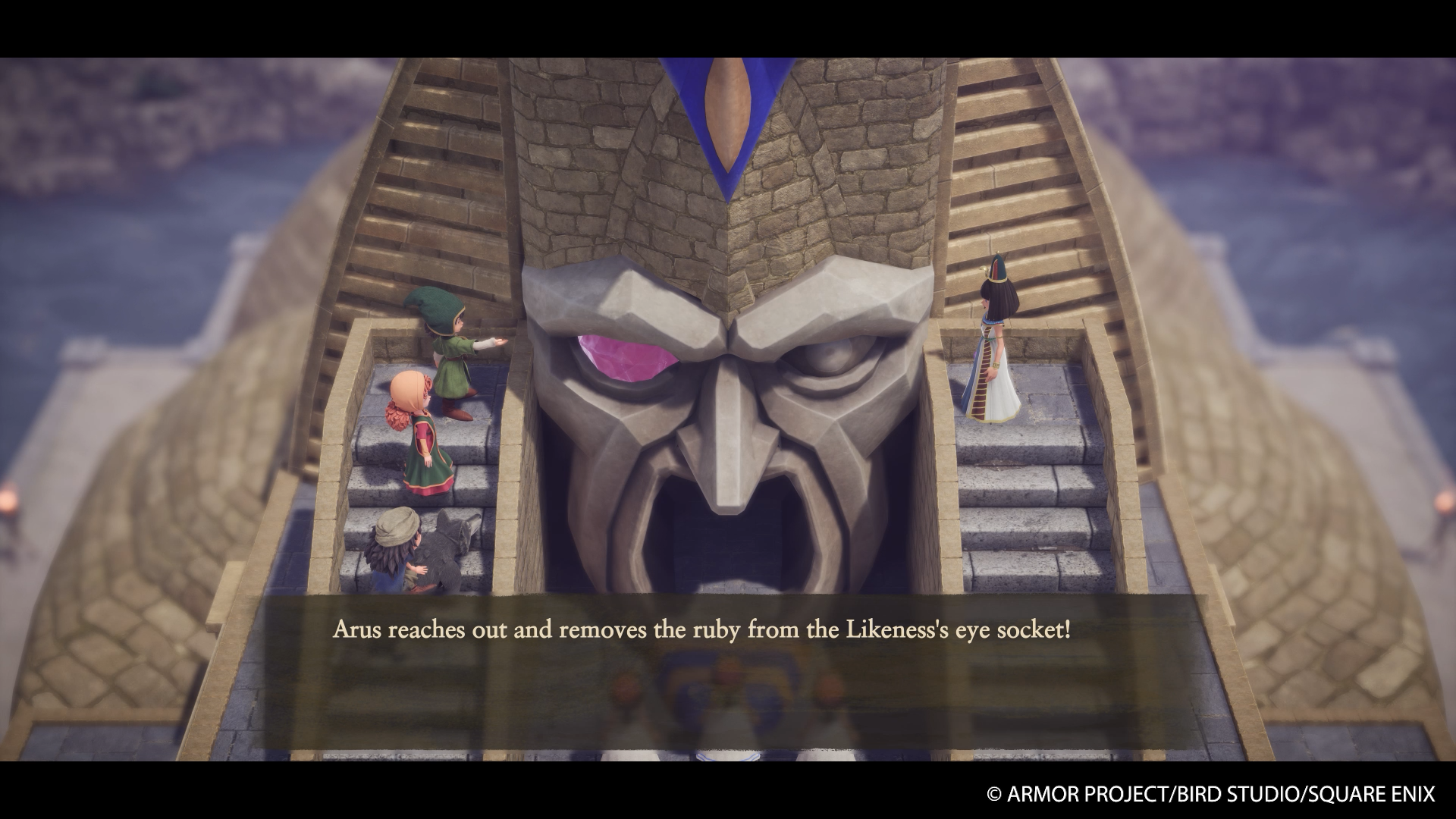
I reviewed the 3DS version of Dragon Quest VII when it (finally) released in English back in 2016. Much of what I said about the story structure and character writing then still holds true now. Dragon Quest VII's short story stylings are somewhat atypical compared to the game's RPG contemporaries, and it might take some getting used to. To rephrase what I said back then, unlike many other Japanese RPGs, the narrative is less about your playable party characters and more about the people of the world — the NPCs you meet at every stop on the way. The many short stories are well-crafted, often emotionally touching, and rarely overstay their welcome. All of this works to give Dragon Quest VII an especially adventurous feel.
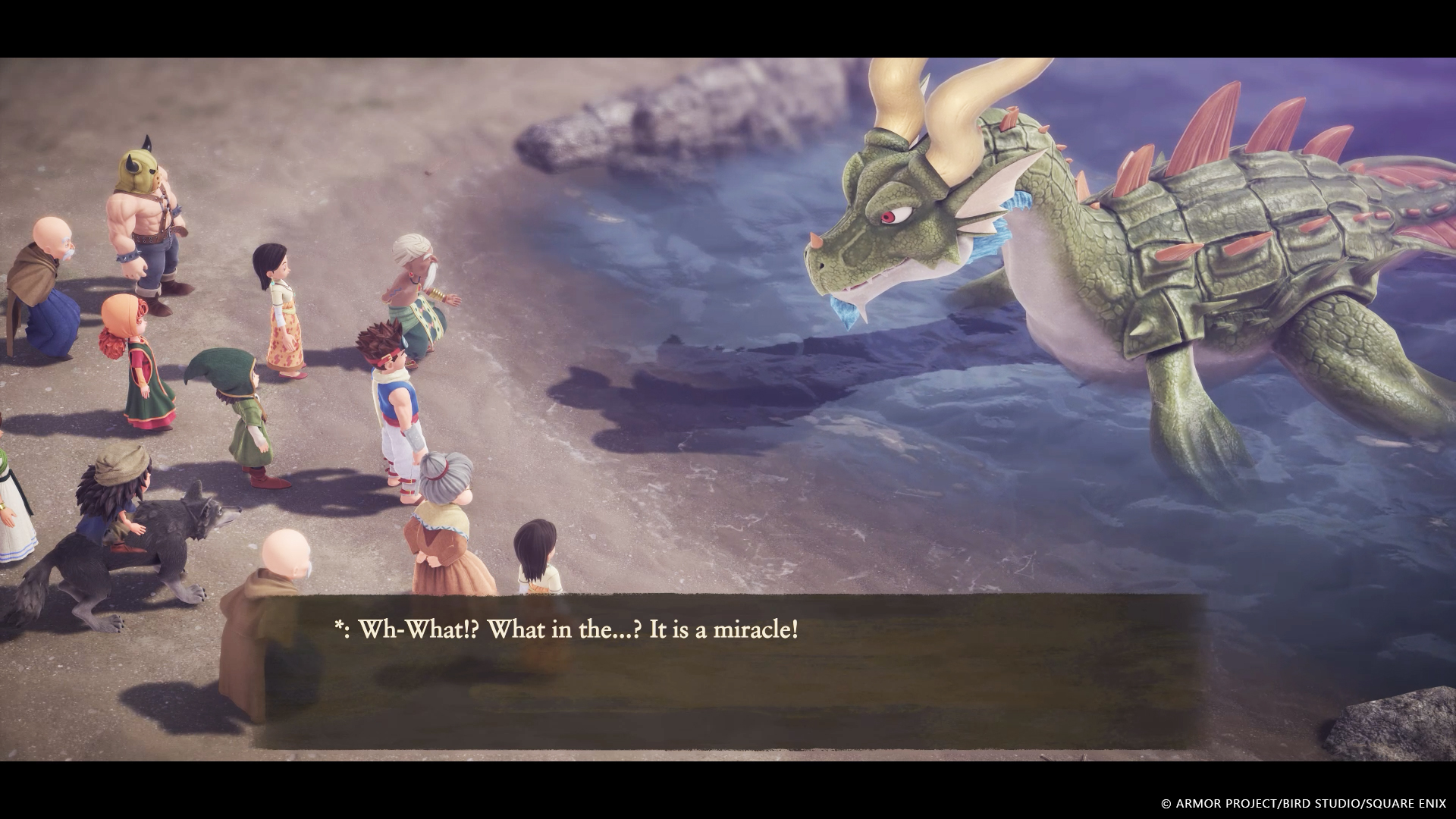
In my 3DS version review, I highlighted the Greenthumb Gardens scenario as a memorable one, involving a complex 'love triangle' of sorts between townspeople of varying status. Here, I'll additionally highlight the Vogograd storyline as one that has stuck with me through the years. The townspeople of Vogograd unknowingly perform heinous acts on a member of their community, and seeing both the response of the victim, as well as how the community handles its history, is compelling without being too overbearing.
To me, these are the moments that make Dragon Quest VII what it is, not the ultimate conflict that necessarily has to happen eventually.
Sometimes, when people discuss the 'pacing' of Dragon Quest VII, I find it hard to agree. To me, 'poor pacing' implies that narrative moments either take too long, resolve too quickly, or detract from the narrative being told. But unlike most RPG stories, DQ7 isn't just all one big story. Most of the scenarios do not strongly intersect with the 'main narrative', and no individual scenario lingers too long. In fact, a part of the game that I think is best argued as a pacing killer — when you have to re-tour the world for elemental spirits — is essentially left intact in Reimagined.
This means that as Square Enix decided to cut some of the storylines in an attempt to improve the game's tempo, it comes across as somewhat arbitrary as to which stories to keep intact and which ones are left out. One of the removed island scenarios is El Ciclo (or 'Litorud' in Dragon Warrior VII on PlayStation). This is a town that finds itself trapped in a time-loop, Groundhog Day style. Is it relevant to the main narrative of Dragon Quest VII? No, not really. If that was the criterion for it to be cut entirely, then there are plenty of other stories that could have been cut, but were not. I felt this was a memorable story with a fun gimmick, and now it's simply gone. And that's it. What else is there to say? I find it kind of a bummer, really.
Even if a scenario is left in Reimagined, some have been trimmed significantly. One example is in the Hardlypool region, when the "underwater city" section of the Sunken Palace — where you battle Gracos — has been completely removed. Reimagined simply takes you straight to the boss battle, instead.
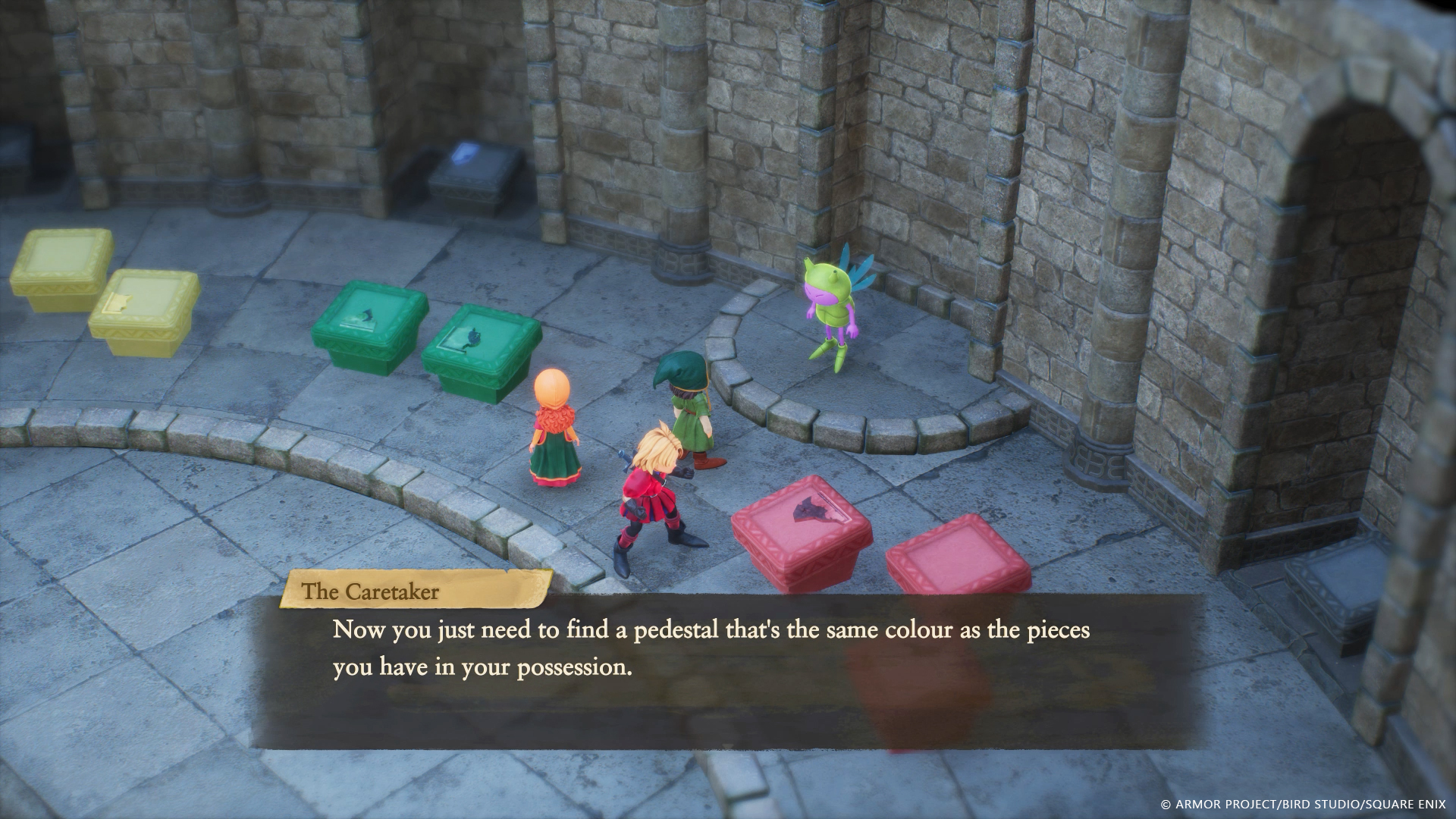
There are a few places where some streamlining makes sense. For example, in previous versions of Dragon Quest VII, you'd have to be sure to speak with Ambrose's granddaughter after the Automaton (Faraday) scenario in order to get a Red Fragment, which is needed to progress. This was something that could easily be accidentally glossed over in a playthrough if you neglected to speak with one unmarked NPC — although the hint system in the 3DS version would eventually point you back in that direction. In Reimagined, Ambrose simply gives you this Fragment during an unmissable cutscene, so it is no longer a concern at all. Condensing certain elements like this seems sensible when earlier versions were perhaps a little too obtuse.
But it's not just about cutting narrative content. All of the efforts to 'streamline' Dragon Quest VII also affect every other facet of the game as well, including battles and exploration. Ultimately, Reimagined sands down every possible frictional edge imaginable, which lessens how engaging the game is to actually play through, even though you can play through it more quickly.
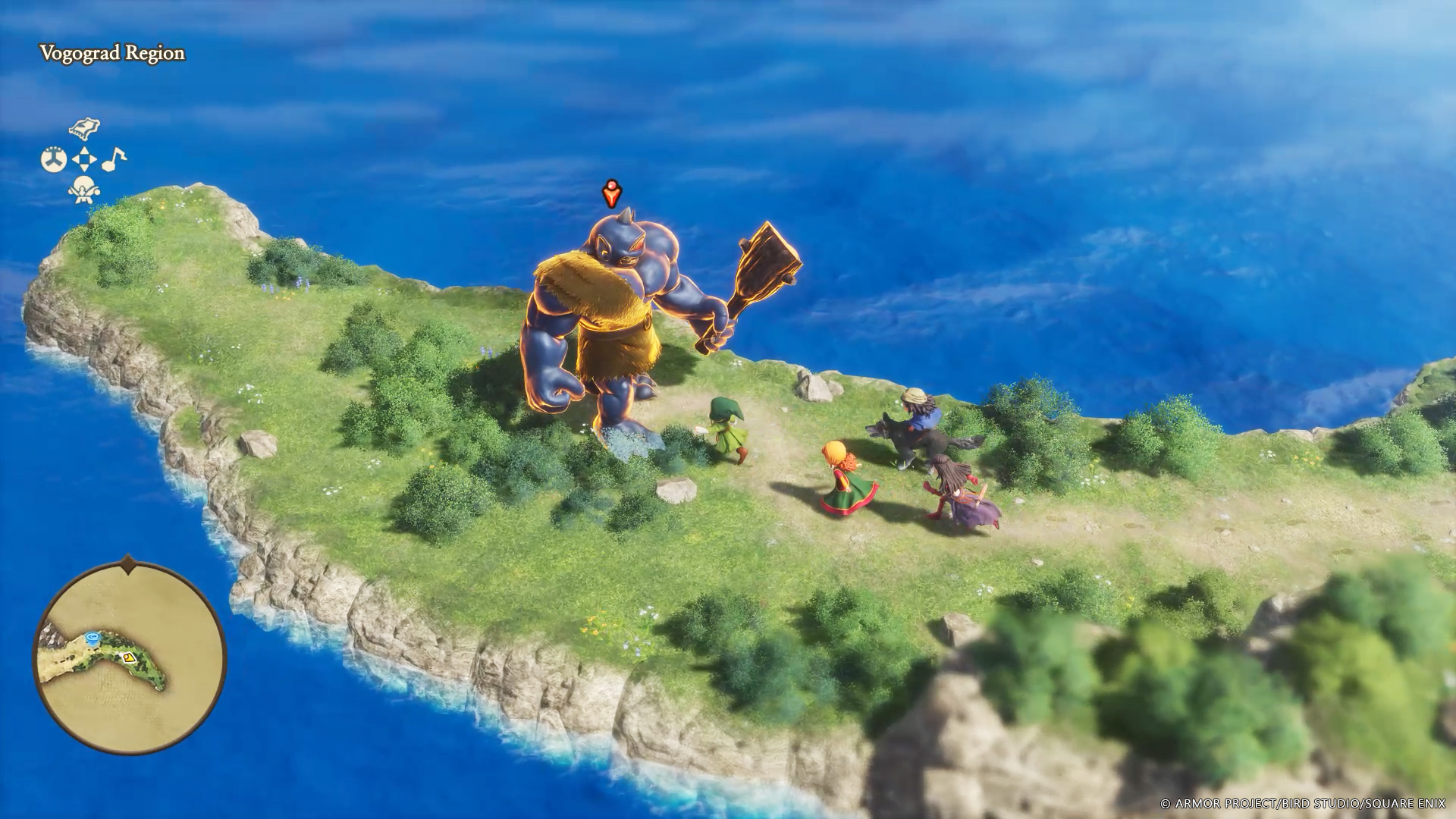
Reimagined guides the player so strongly as if it is scared to let them figure out anything on their own. Even if you turn off objective markers in the menu, this only removes them from the world map. Markers will still be visible in every town that you go to, showing you exactly who you need to speak to in order to proceed. The game's map menu will also tell you, in writing, exactly what you should be doing at any given time. Carried over from the 3DS version, the game will automatically use key items in the right spot for you, where in the original, you had to recognize yourself where and when to use them (for example, the Holy Water in Burnmount, or the Angel Tears in Greenthumb Gardens). Party characters interject with clues more often, regarding things like where to find the Golden Horns for Hadid, where to get medicine for Greenthumb Gardens, or where to find Prism Dew to use in the Buccanham region. Many of the Party Chat dialogues also boil down to clues about where you should be going.
But it goes beyond just 'how to progress the story'. Many other components have also been sanded down when it comes to exploration and battle. Both tablet fragments and Mini Medals are simply listed in your menu; it tells you exactly where you need to go to pick up these items with a click of a button. Fragments also appear clearly on your minimap, regardless of your game settings. The Nose For Treasure ability has been powered up, listing unclaimed items not only in the current region but also in the adjacent areas. The game throws *so many* Medicines and Single Phials at you, and there are no individual inventories to manage, meaning every character has access to all items at all times. Compared to previous Dragon Quest VII releases, Lucky Panel has been expanded to include more weapons, more equipment, & stat seeds, and it is completely free to play, so you can easily get tons of free equipment to use or sell.
I can go on: There are more Sacred Statues scattered throughout the world that offer free full heals, so resource management is less important. Since you can train two classes at once, you gain vocation points much faster than you could before (and Vocation level limits are no longer enforced as they were in the PS1 and 3DS versions, so you can easily overpower your vocation training with weak enemies). Characters can no longer "die" if they fall to 0 HP during a battle; they'll always be revived afterward with 1 HP. Even if you do submit to a party wipe, instead of the usual penalty of half your total gold, you only need to pay 1000G to continue without losing progress. Especially later in the game — when a party wipe is more likely to occur — you are probably sitting on tens of thousands of gold, so paying 1000G is practically nothing. You could earn that back in one or two battles.
What this all ultimately comes down to is that the game doesn't leave much for the player to discover on their own. The game tells you exactly what to do, when to do it, and gives you an overabundance of tools to succeed. There's no exploration to be had, few problems to solve, and only small hurdles to overcome. It leads to an experience that is definitely streamlined, but less satisfying. While there are difficulty toggles that can affect battle challenge, it is only a small consolation when most everything else outside of battles is unaffected. In an interview prior to the game's launch, Square Enix stated that "We are developing this to be the 'Masterpiece' version of Dragon Quest VII." Instead, I feel like we've received Diet Dragon Quest VII.
So, Square Enix did succeed in quickening the tempo of Dragon Quest VII, as Reimagined's main story can now be finished in 40-50 hours. But an adventure with a paved path so clearly drawn in front of your feet is less interesting than an adventure where the trails are obscured, at least a little bit.
Square Enix has also boasted that there is new content added to Reimagined, seemingly to offset some of the cuts made. What this actually manifests as is a 10-minute sequence that justifies Maribel staying in your party (unlike previous versions, where she has to leave for an extended period), and a 30-minute sequence that revisits Kiefer as an adult (which was teased in an earlier trailer). The new Kiefer content includes a stealth section, too.
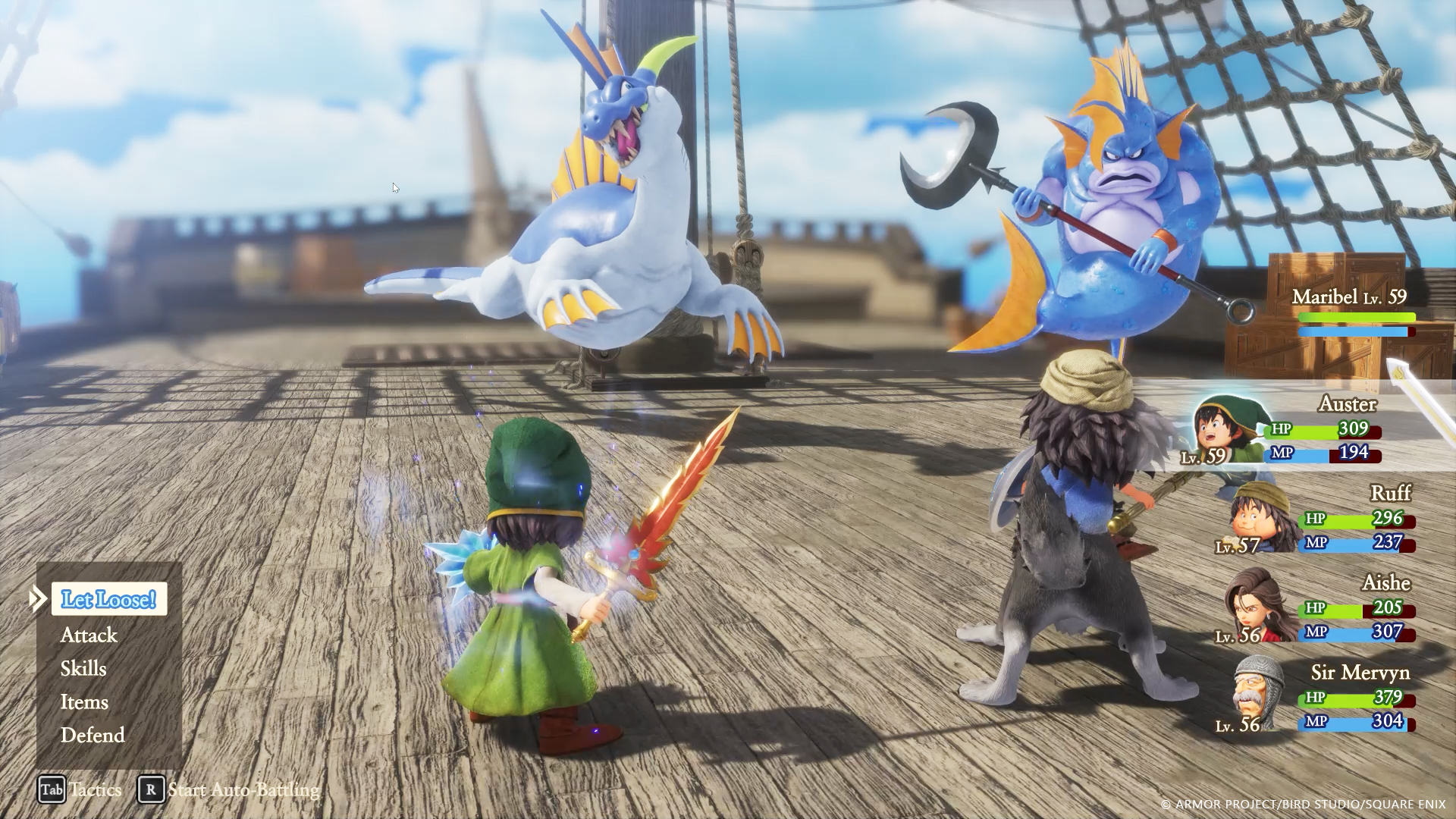
Out of everything that Dragon Quest VII Reimagined offers, the biggest highlight probably comes from the battle system itself, with mixed feelings. When I interviewed producer Takeshi Ichikawa last month, he told me that he "wanted to make the standard encounters with mob enemies quick & streamlined, while making the boss battles rather deliberate and strategic." To this end, I would say he succeeded. One of the reasons Reimagined is much faster-paced is that regular battles are both easier to clear and easier to avoid — if you don't feel a need to fight. Boss battles are probably where the game shines brightest, mechanically, even with all the aforementioned caveats on game balance. Boss encounters in the post-game are genuinely challenging, requiring the player to properly prepare their party with appropriate classes and equipment, followed by well-executed tactics in battle, as any good turn-based RPG should.
I'm also a little bit mixed on the new 'handcrafted' visual style. I think it looks great in battles, and I think it looks great in the rare fully-animated cutscene. However, most of the game is from a top-down perspective with simple, repetitive animations and often without voice acting. It can feel somewhat cheap, and I sometimes found myself wishing we had kept sprites instead. There's also a tedious depth-of-field effect on the game's overworld that I could have done without.
Dragon Quest VII Reimagined still encapsulates much of what makes Dragon Quest VII resonant, but with every possible edge sanded off. It succeeds at streamlining a lengthy adventure at the expense of player discovery and friction. Besides being able to reach the credits more quickly, I find it difficult to declare this version as an improvement on what came before.