"I'm mostly interested in solving impossible problems" – Brian Bucklew Discusses Caves of Qud's Development, the Switch Port, Expansions, Coffee, and Much More
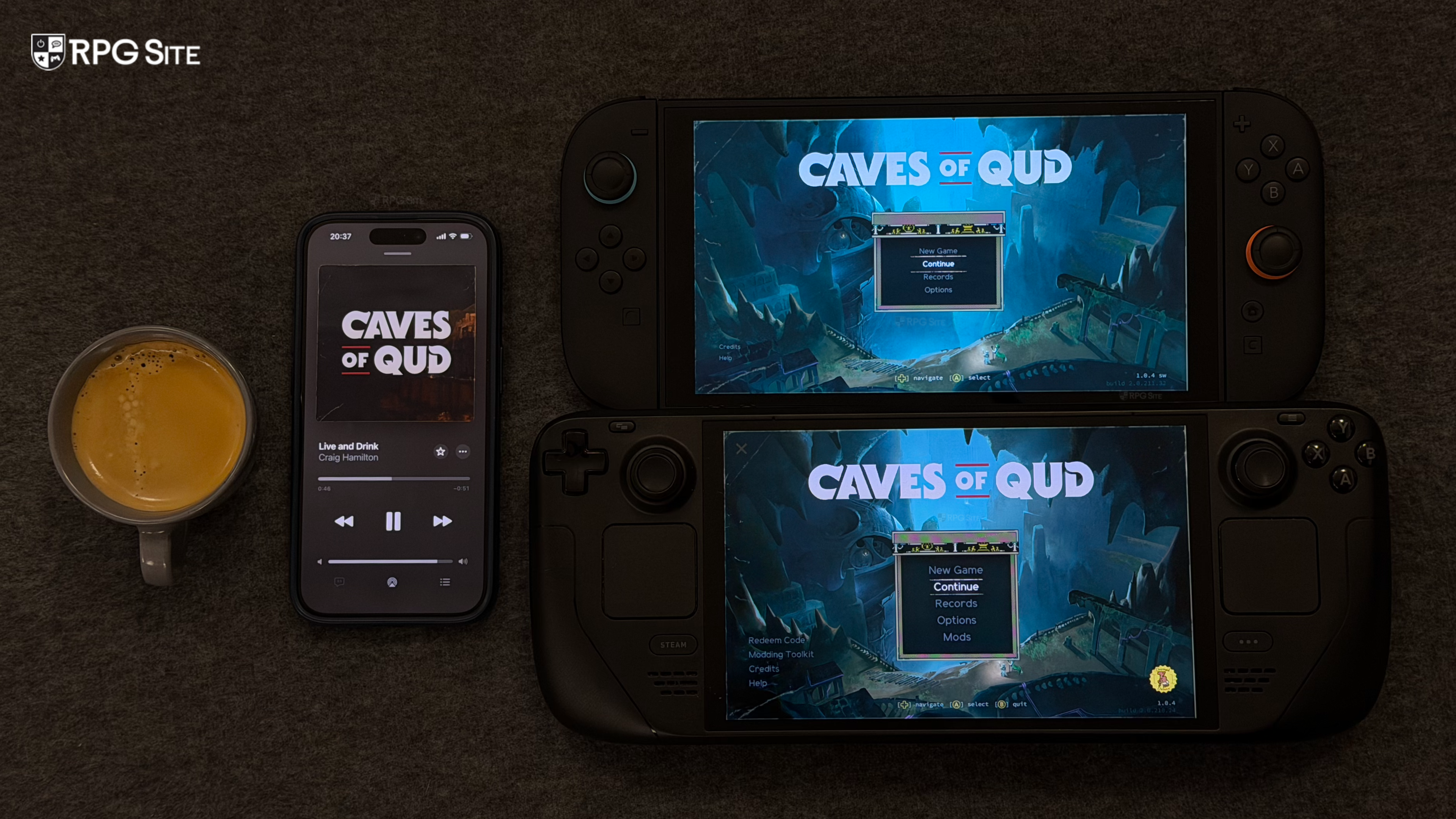
Back in February, the science fantasy roguelike RPG Caves of Qud from Freehold Games and Kitfox Games released on Nintendo Switch. A month after its Switch launch, I had a chance to chat with Freehold Games' Brian Bucklew to discuss the many years of development it took to reach 1.0 on PC, his approach to development, the state of Caves of Qud now, new expansions, controller support, the Switch port, Yakuza games, coffee, and much more. This interview was done on a call. It has been slightly edited for clarity.
Advertisement. Keep scrolling for more
RPG Site: For those unaware, tell us a little bit about yourself and what you do at Freehold Games
Brian Bucklew: My name is Brian Bucklew. I've been making software since I was 14 years old, which was more than 30 years ago. I'm one of the co-founders of Freehold Games. Now our studio is a little loose in terms of size. If you extend the size of our studio to like all the people who work on social media, it's like a couple dozen people. The core development team is about six people who scrum, plus a couple of additional developers who work on music and art, not sort of in the weekly cycle. It's a pretty large team for a tiny studio now.
I was the technical co-founder, so I sort of built the technical engine along with Jason Grinblat who did the design and writing and also does some of the code. We founded the studio in the early 2000s not knowing we were going to make video games at all, but rather we were making all kinds of little projects. Caves of Qud originally came out of a tabletop game world we were working on, and some early RPGs playing together, Rifts and Gamma World, and we eventually folded a bunch of projects together, a roguelike and this tabletop RPG into the project that would become Caves of Qud.
And here we are now a couple of decades later.
RPG Site: When people keep bringing up that it has been 17 years in the making, what exactly does that mean? What was the starting point for Qud?
Brian Bucklew: The starting point for Qud, I think, is quite diffuse. Jason and I have been making games together since we were teenagers, and playing games together, playing games like Dungeons & Dragons, and Rifts, and Gamma World, and playing Doom 2 online on old BBS connections dialing up multiplayer. We have quite a long lineage between us of developing these games. We worked on multiplayer MUDs early on. So we developed a bunch of these, sort of, initial seeds of projects that never got finished, like many people, just sort of developing our skills and figuring out what we like and developing our tastes.
At this time I had been spending many years, and I've given some talks about this, trying to make a roguelike engine. I was playing games like Omega and Atom, and roguelikes like that, that had these big worlds, and I thought with the hubris of youth, I could do this technology so much better. I kept trying and failing, because the complexity of that engineering task is quite high. It's quite difficult. Then in the early 2000s, there were some papers by a guy named Scott Bilas who worked on Dungeon Siege who had built a component-based software architecture which was novel at the time. I said, "Oh, this is pretty interesting."
In his papers, he gave some directions for what he might do if he built it in a more modern language like C. At the time, C# had just come out, and I was like, "Okay, well, let me try to build one of these component-based engines in this new language C#, and see if I can really get it working to build this roguelike engine in the way that I'm imagining." And it worked.
In fact, the way I built Caves of Qud under the covers in those years, was almost exactly the way Unity 3D was built under the covers, based on, I think, the same papers and technology of the time. It ends up being quite an effective way to build games using this composition structure. At the time I was building a pretty basic fantasy roguelike, and at that same time Jason had been developing a fantasy world that was sort of what we called the Freehold setting sci fantasy really not not fantasy.
At some point we just said, well, instead of doing a fantasy roguelike and a sci fantasy tabletop RPG, what if we tried to do these things together? What if we tried to fold a sci-fantasy setting into a roguelike technology and format? Would this game even be fun, because these games are sort of about these fantasy dungeon delves, and can you make this game at all? That was sort of the genesis of Caves of Qud was taking this sci fantasy setting that Jason had been developing, and folding it into this roguelike technology that I had been developing.
RPG Site: Looking back at the early 2000s and where we are right now, would you have approached something differently back then if you could go back in time?
Brian Bucklew: I think through a lot of luck, we've actually been very fortunate to have made a lot of right decisions. I don't think that that's attributable to anything other than good fortune. We sort of lucked into good architecture separating Unity from C#, because Unity didn't exist when we started. So we had built the technology to be separable from Unity because at first it was separated from Unity, right? I think that we made just a design choice based, I think, on curiosity, which was, "Could we make the user interface menu driven, instead of what was traditional for roguelikes at the time, an interface driven by a bunch of individual keybinds that were pretty hard to discover?"
That was part of the gameplay at the time where you had to figure out that W was Wipe and F was Fall down and S was Sing. And we said, is that actually inseparable from the genre or can we make it so that you just pop up a menu with those things? Is that too easy? It turns out that it's not too easy. It's still quite interesting and confusing for people. But that eventually makes it playable on Nintendo Switch, because now instead of having a bunch of keybinds, you can go through these menus. I think that that was basically just luck, right? I think that we also run on Switch because we started this so long ago.
This game had to run on computers circa 2006-07 and it really pushed the computers at the time, but now those computers fit in our pocket, right? I think we still push the computers that fit in our pocket now, but it does run. So I think I think the game kind of works in the way that it does because we've been sort of fortunate that the choices that we've made map to the kinds of ways people want to play today.
RPG Site: Having tested thousands of games on Switch over the years, Unity ports seem to struggle a bit more and sometimes have issues like the 50hz one or just really long load times. What were the challenges you ran into with the Unity-related parts of the Switch port?
Brian Bucklew: I think Unity is often a very dualistic kind of environment to use. It does some things very very well. So when I first used Unity on Sproggiwood, which is a game we made in between starting and finishing Caves of Qud, as an experiment. Could I make games on this platform? It has some upsides like it makes great use of C# which means I can engineer big projects in it.
The second thing I found that it did very well, was that it went to other platforms very seamlessly. So I was able to compile Sproggiwood for Mac, Linux, Windows, Android, and iOS with very little problem. So it made that kind of porting very easy. The other half of Unity's dualism though, is that their larger systems tend to be underbaked. Their basic systems work really well and then the more elaborate systems tend to not be quite enough to actually make a good game if you try to use Unity's systems built in.
Their input system that we use for Caves of Qud in order to make gamepad controls work, the basic input system works marvelously. It gets all the inputs from Switch. It gets all the inputs from all these gamepads and unifies them, but when I tried to use its input system to do higher level stuff, for instance, track a modifier key being held down, I would just find bug after bug and it took years to work through.
Eventually what I ended up doing, which you end up doing for almost all of Unity's high level systems, is just write it myself on top of the lower level systems that work cross-platform. So I think that in a lot of cases what you're seeing with games is that games are very hard to make. People are using these higher level systems which are often a little underbaked and don't quite work. You can make Unity very performant, but all of a sudden you're writing a lot of the stuff yourself. You're writing loading systems from scratch. You're writing C++ modules to do calculations for yourself.
So I think people get in there and use these underbaked higher level systems, whereas Caves of Qud, because of its history, we tend to just use the lower level systems. It'll work very well. They'll let us go very easily to Switch, they'll let us very easily hopefully go to mobile. So that's pretty much it.
RPG Site: How long ago did you start work on the Nintendo Switch port if you can say?
Brian Bucklew: We started the Switch port in the first half of 2025. I don't remember exactly when. So it took less than a year, with our porting part partner Laundry Bear who are great, and certainly much more experienced in porting than me, to get it ported to Switch. For a whole new platform, that's a pretty astoundingly short time in my view.
RPG Site: I was expecting you to say something like 3 years, and then a few years optimizing it, because of the CPU requirements.
Brian Bucklew: Much of the work that was necessary for Switch, like gamepad controls came before Switch, to go to Steam Deck, right? We chose Steam Deck as a platform, and said, "Well, we're going to launch on PC and Steam Deck. That will prove it for consoles." That work did take many years.
It took around three years to do the full gamepad implementation, to do the new user interface, which allowed gamepad controls to work, and allowed us to get off of the keyboard as a necessary modality. So if you count that work, it did take around four years total. But once it was running on Steam Deck, the port to Switch took less than a year
Advertisement. Keep scrolling for more
RPG Site: Initially, I was concerned that the Switch version when played on Switch 2 wouldn't look as good as it should given the scaling and the art. Qud looks perfect on Steam Deck, but it didn't on Switch 2 initially. That got sorted now with handheld boost mode. Are there any plans to do a native Switch 2 release? It would be great to also have Joy-Con 2 mouse controls.
Brian Bucklew: Obviously everybody's asking for it and we're investigating it. We're interested in it. We'll see how it goes.
RPG Site: Before getting into the narrative, I wanted to give you a bit of background on how I learned about Caves of Qud. Leading into the 1.0 launch, Kitfox was working with popagenda PR who reached out to me about it. I recall only requesting a key after confirming it had controller support, which remains a very impressive aspect of Qud, but the bigger surprise was the many game modes included like Roleplay and Wander. You usually don't see these kinds of options in games like this until years later.
Brian Bucklew: I think it's funny to hear that perspective because from our perspective, they are years after launch basically. We entered early access in 2015, right? We had our first public playables, which were just free shareware, in 2010. So by the time we came to launch, we had been publicly played for 14 years. I think over time the answer to how we got there was that Qud's a hybrid beast. It's a run-based roguelike underneath the covers. It was built to be played in traditional permadeath mode, but it has a very long, complicated, high stakes computer RPG, not quite stapled to it, but it really is indelibly interwoven, but they're they're interwoven, but sit beside each other. There's some tension between an RPG that you're going to invest 30 hours and really build up a character, and this run-based roguelike with high stakes.
Some people really enjoy that tension, right? But one of the things we really wanted to do with Caves of Qud is we thought that this format really should be accessible to a lot of people, right? In a lot of ways. It's a turn-based game, which means it can be physically accessible to people who can't play other kinds of games. It's largely textbased, which means we should be able to take it to screen readers, which is something we haven't done yet, but something we want to do. We thought that there's a lot of people for whom this high intensity, very lethal, classic mode is exciting, but there's a lot of people for whom this is just not accessible. As we got older, we started this game, we were in our 20s. Well, now we're in our 40s, we have children. I can't invest a thousand hours finishing an RPG anymore. That's not an accessible amount of time for me to spend on something anymore.
So, increasingly, as we mellowed, we said, well, it's silly to lock this RPG behind classic mode. It's great to have, right? Like, we built it. This was the original intent, but nothing's really lost by allowing checkpointing. This is just a different way to play. I mean, we thought about it a lot. There are many ways we could have done things like straight save load. We thought about it a lot and picked a particular role playing mode that we thought kept some of the danger, kept some of the risk in a run without sacrificing the ability to finish an RPG if you have an adult life, right? Like losing 30 minutes of play into a dungeon is more than enough risk for me, that I don't need to lose 30 hours of play on a character.
And so we added Roleplay mode. We also found that there are some people who really enjoy the texture of the world, and reading the world, but even in Roleplay mode, the combat's quite demanding. It's a hard game to play. The people who are really roguelike and RPG hardcore say, "Oh no you can break these systems. The game's actually too easy yada yada yada," but I think for most people, it's actually still very very hard, right?
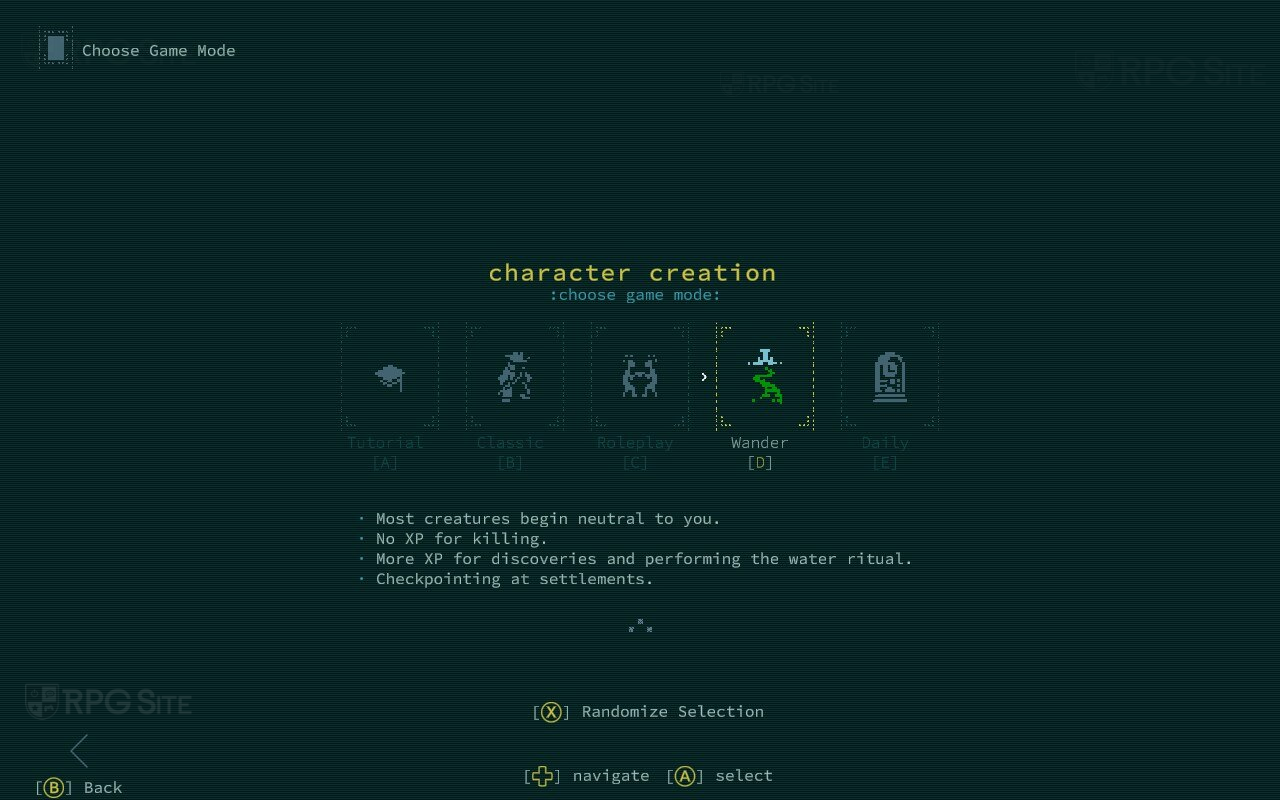
We said, well, there's a lot here for people who don't want to engage with this very hard combat system. What if we added a mode that allowed them to just engage in the texture of the world, and that's Wander mode, right? We think that the these allow you to take a different rotation of the game that is accessible to whoever you are, and your interests in play, because it turns out that the intersection of people who can play and win the very challenging tactical side of the game, and the people who can read all of Jason and Caelyn's elaborate writing and understand the plot, that intersection is pretty narrow in fact, right? *laughs* A lot of people will enjoy one or the other, and not both of them.
RPG Site: When I first booted up the Switch port, it had been a few months since I played Qud, and I was deep into No Man's Sky again. It has a ton of new modes and modifiers now across updates. I was curious if Qud went through something like this where the original was the base, and over time with player feedback, you wanted to make it more accessible resulting in more game modes and modifiers. Are there any plans to just give players a full custom mode with sliders to do whatever they want? Maybe even a god mode?
Brian Bucklew: Well, there is god mode if you want to turn it on. There's wishes in the game, which mean that you can play it however you want. If you go on the wiki, someone has listed, the player community has listed out all of the wishes which are very powerful. It's also very moddable. I think for custom game modes, for PC at least, I would encourage you to dabble in modding because I think all of us got started, all of the indie devs I know got started modding other games.
One of the things we've really focused on Caves of Qud underneath the covers, is being a very data driven, very moddable engine. You can do a lot and you can actually do a lot of interesting custom stuff without knowing how to code at all, just in data.
I guess my secret plan is to get more people saying, "Oh, I could do this better or more interestingly, or I want this in Caves of Qud," Actually, you can go on the wiki and go to the modding section, which is lovingly curated, and learn how to do it, and add stuff to the game quite easily.
RPG Site: This is a two-part question. How involved were you early on in the narrative with Jason, and are you happy with the state of the narrative right now? It think the narrative is incredible, but I'm curious what you think about that aspect now given you are still updating and working on the game.
Brian Bucklew: I think the narrative is one of the most compelling narratives in games, and is interesting for a particular reason, which is it's a specific narrative which is only able to be told through these interactive systems. I don't want to give anything away, but there's really important elements of the plot, as you get to the midgame, as you get to the endgame, which systemically take what you've done, and tie it into the story itself.
You couldn't tell the story we tell in a book. I think many many games tell stories that you could novelize, and I think Caves of Qud tells a story that has these static elements which you could write into a book, but it's sitting on the foundation of a systemic story which is about the player, in a way that the game recognizes, in a way that a non-interactive media couldn't write on a page.
I think when you look at a text-based group, you would not think that it would win the IGF narrative award, right? Like it's a tactical crunchy roguelike, but I think that the work that Jason and Caelyn have done in creating the systemic story is, I think, rightly recognized by IGF and Hugo as really groundbreaking stuff.
From that perspective, I'm more than happy. I can't believe we did that, right? It's pretty incredible.
RPG Site: There's a funny disconnect when I introduce Caves of Qud to friends where they see an award-winning indie, 91 on Metacritic, and then they look at the visuals and ask me if it is Dwarf Fortress or something. I keep saying it is worth it, and they give it a go and die in like five minutes.
Brian Bucklew: It's funny because the early game is quite simple, and in part you play through a set of layers that is our own game design sensibilities maturing. So the early game, we developed by and large when we were in our 20s. By the time we've built the game for a few years and have the systems together, we build the dungeon Golgotha, which often people never pass. It's quite difficult. It's a new kind of challenge. It's sort of the gateway into what I kind of think like real Caves of Qud, but it's a test in so many ways for a player, but it was also a test for us. It's the first time we said, "What if we did something that wasn't a traditional dungeon? What is something we can make that is really unique to Caves of Qud and feels like a unique experience?" So after you pass through Golgotha, the main quest opens up. We get more and more experienced and build content in Caves of Qud.
Unlike most RPGs which are often front-loaded, the most interesting and detailed stuff happens in the beginning, and it kind of peters out as you get to the end as the team runs out of time, and runs out of resources, and just has to finish the game. Caves of Qud is inverted. The deeper you get in the game, the older and more experienced we get, the bigger the team gets, the weirder we get with the stuff we're making. So that by the time you're getting to the endgame, it's a completely different experience because we're making it almost 20 years apart. Red Rock and the endgame are almost 20 years difference in terms of the team experience and our ability to craft and just having things to say about the world when you're 40 instead of 20, right?
RPG Site: How much work have you been putting into the world simulation aspect in recent years? Is that something which you consider done and you're just polishing it up now?
Brian Bucklew: We're working on expansions. We have a bug tracker with like literally 10,000 bugs in it as well as a huge bucket of stuff to do for the expansions. So I think that if we wanted, we have 200 years worth of work to continue to do both in performance and expanding it.
I think anybody can look at it and say I can think of a million ways to expand this right and people do like the mod Hearthpyre adds a whole base building system. The mod author for that is a core member of the team, and has been for many years, because we said "Wow, that's an amazing mod. Do you want to help develop the game?" So like that's just one axis of possibility for the world of Qud. I think with 1.0, if we left it there, we would be okay with it.
I think we've said the things we've come to say, but I think there are at least a handful of other very interesting expansions that we're excited to build, that we think develop the game, each in a unique way, and tell a unique and interesting story. Maybe a little different than people would expect, but I don't think anyone actually wants to come to Qud and see like 20% more of exactly what you have in Qud, right?
I think you want our expansions to be something a little different, and I think that that's what we will make and people will enjoy.
RPG Site: I can't even imagine how much time it would take to 100% the current state of Qud. How much time would it take to see everything including all the lore?
Brian Bucklew: I mean, people play literally for 5,000 hours and say, "I've just seen something new I've never seen before." I think probably if you played for 500 hours, you've seen a lot of what we have. You probably have missed some things, but you've got a pretty solid amount of time in it. But if you want the people who really really break the gameplay for two, three, four, and even five thousand hours, and still are running across new situations that they haven't seen before.
Advertisement. Keep scrolling for more
RPG Site: You mentioned that doing all the work for the Steam Deck helped with the Switch port quite a bit. I want to discuss the controls. When I first played Dwarf Fortress on Steam, I remember looking at all these custom Steam Input layouts people had with radial menus and stuff because I'm lazy. I don't like using a keyboard or mouse anymore. Caves of Qud is very different with its controls compared to Dwarf Fortress despite the comparisons you see online. What were your influences for the UI, menus, and text? I love that I'm never overwhelmed by it.
Brian Bucklew: So the UI system is a combination of influences. The gamepad controls, I think, are actually helped by the fact that we're a very old school game. I think that when you try to take a game that's mouse and keyboard first, adding gamepad controls actually is quite hard because often you have like very dense areas that you're moving a cursor over, and hover matters, and you have a bunch of affordances with a mouse that you don't have with a gamepad. So when you try to take Civilization and turn it into a gamepad game, you're faced with a bunch of really tough challenges.
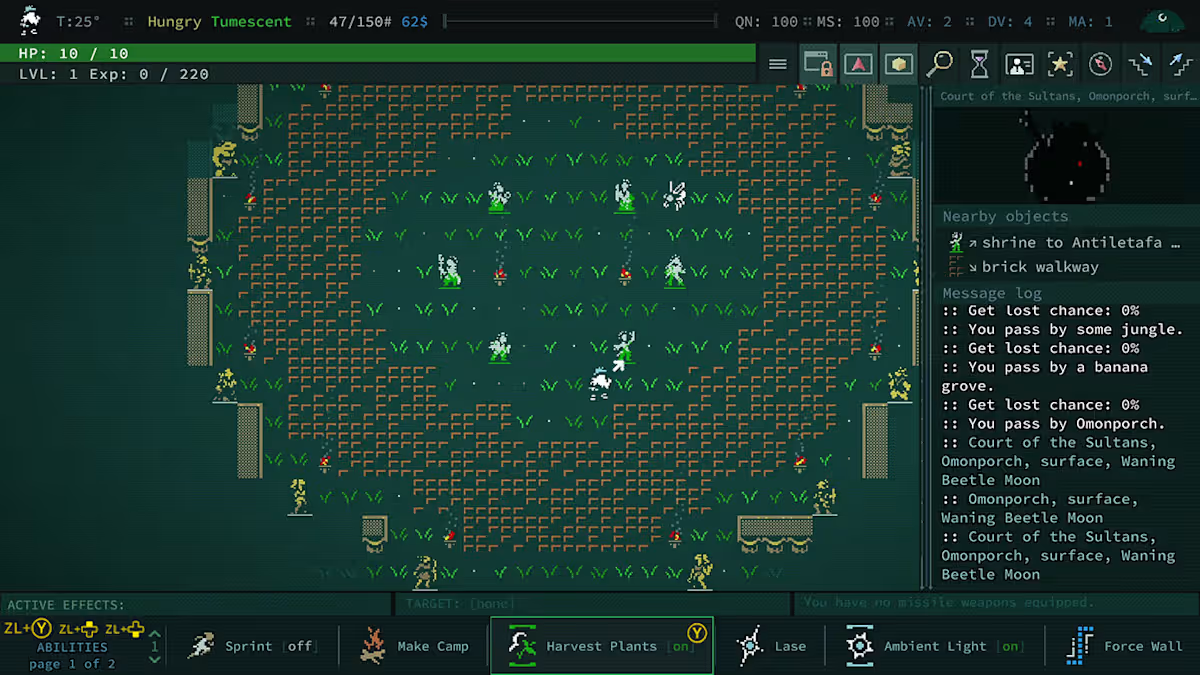
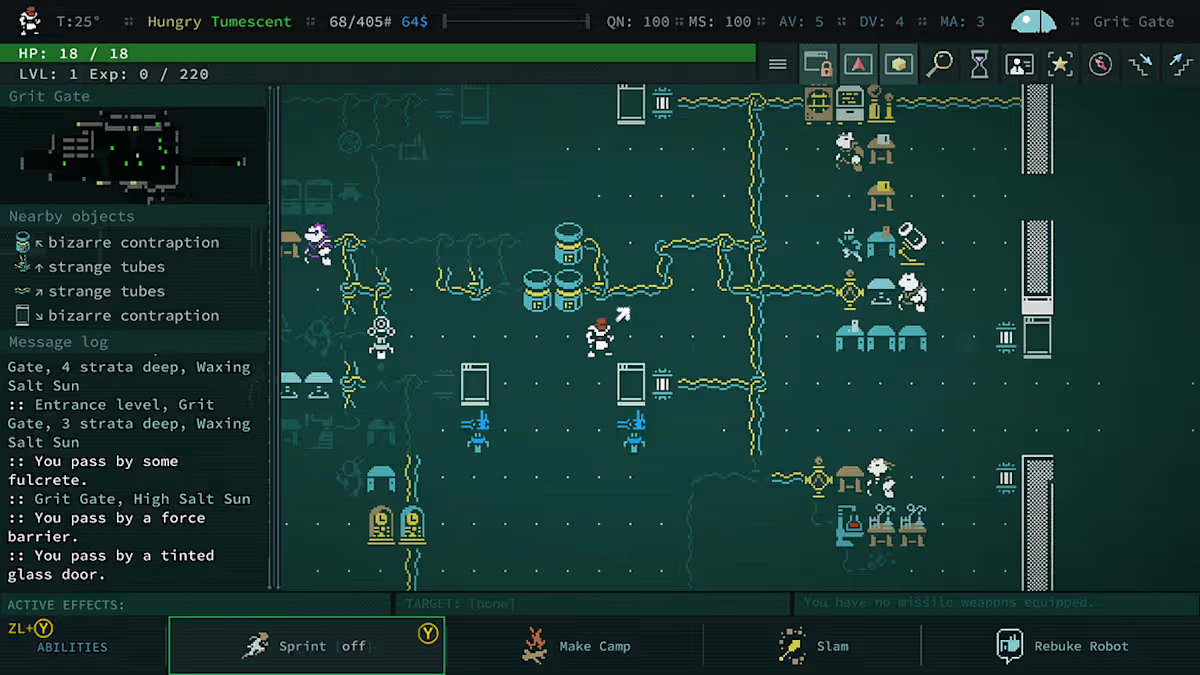
We started as a keyboard driven, arrow key driven, keyboard game only. No mouse. Which means that we didn't build in necessary affordances like mouse over hover, the need to scroll the map with a mouse. All of a sudden that makes a gamepad actually more possible than a mouse-based thing because we already have a very discreet set of UI elements on the screen. It was originally, and I don't know if you tried it, it was originally a completely text-based game. There was no graphical UI at all. You can still turn on this mode. Which means each screen had an amount of information that was presentable in an 80 by 25 text-based mode. Right? We had to get very concise. There's only so many clicks to move around on that screen. So many arrow key taps. The modern graphical user interface is a design by a designer named Polat Yarisci in Turkey who came and presented basically fan art, and said this is what I could imagine a Caves of Qud UI looking like.
We saw this fan art and we were like, would you like to actually make the real user interface? And Polat said wonderfully, yes, I would do that. That was his design. I don't want to take any credit for that. It's just totally brilliant. Polat came from a unique background doing a lot of print and magazine layout. So his background is in print layout, which is uniquely suited to Caves of Qud, I think because he thinks a lot about text layout and its framing.
So when Polat came in with his incredible pixel plus his real talent for doing text layout and formatting, and combined it with what was originally a very concise text-based UI, suddenly we have this unique route into a gamepad playable interface where you're giving discrete arrowpad like inputs, through an amount of text that now you can see more in the modern UI, but originally we designed the game to fit in this very constrained space.
So even when you let it out, it's readable, right? It's navigable with a controller, and then our main streamer and writer Caelyn played a lot on gamepad, and came up with the specific mapping of buttons just through playing, and playing, and playing, and saying this should be on this key, and this should be in that key. So it was quite a big team effort from a bunch of people that just really loved Caves of Qud, and brought their unique talents into Qud. Plus the 20-year history of coming from a really old school style game that made what is here possible.
RPG Site: The print layout stuff blows my mind because it all makes perfect sense now looking back. I always thought the highlights, color choices, and general elegance in the UI were all amazing.
Brian Bucklew: And I was going to say his UI in the mockups is even better, and like in terms of the number of colors, I did some damage to it in making it actually playable and something that I could actually code. So he did an even better job than is present in the game and it's basically limited by my technical abilities.
RPG Site: You've been working on touch controls for the mobile port, and we've chatted on Bluesky about how you said you were planning on making it a portrait game on mobile. I'm curious about two things. The first is whether you plan on bringing touch controls from the mobile version to Switch port as an optional input method?
Brian Bucklew: I think it's going to be a pretty different play experience. I don't know. Like right now we're still in early designs on it, trying to understand what each screen looks like. This process is quite long and iterative. The first step which we're going through now, is simply to block out each individual screen, and say what is the best way to do this individual screen in a portrait.
And then with 30 screens, we have to look at all of them and say, "Okay, how do we normalize all of these screens?" They all want a back button. Can we put them in a usual place? They all want a drawer of information. Can we make this drawer normalized?
We're still really in the first stages where we're trying to figure out how each individual screen works. Then later, we'll do a big normalization pass and playtest it. And so it's quite an involved and difficult process and once we get there, I think it will mostly make sense on phones, and maybe it will make sense on Switch, but I'll have to understand exactly how it works before understanding how it works on other touch-based platforms.
RPG Site: I initially thought maybe an iPad version would be pretty simple because you could just bring it over with the same UI. It will not be be 16:9, but I thought the current UI would work well. Holding the trigger button on the gamepad made me think about how you could tap and swipe in a specific direction to move. That might save space for other UI elements.
Brian Bucklew: I think there's a simple implementation where we basically take the gamepad controls, and you just hold the phone like a gamepad, and it would probably work, right? I think to me that feels like the worst case scenario. I think it would only work and wouldn't feel like a natural game, right? I think there are plenty of games that just stick the gamepad on the screen and you can play like that, but I guess I'm mostly interested in solving impossible problems.
The impossible problem of making it feel like a native phone screen, is appealing to me just from what I want to do with my life perspective, right? I don't know if we'll succeed. Maybe we'll fail. It's a very very hard problem.
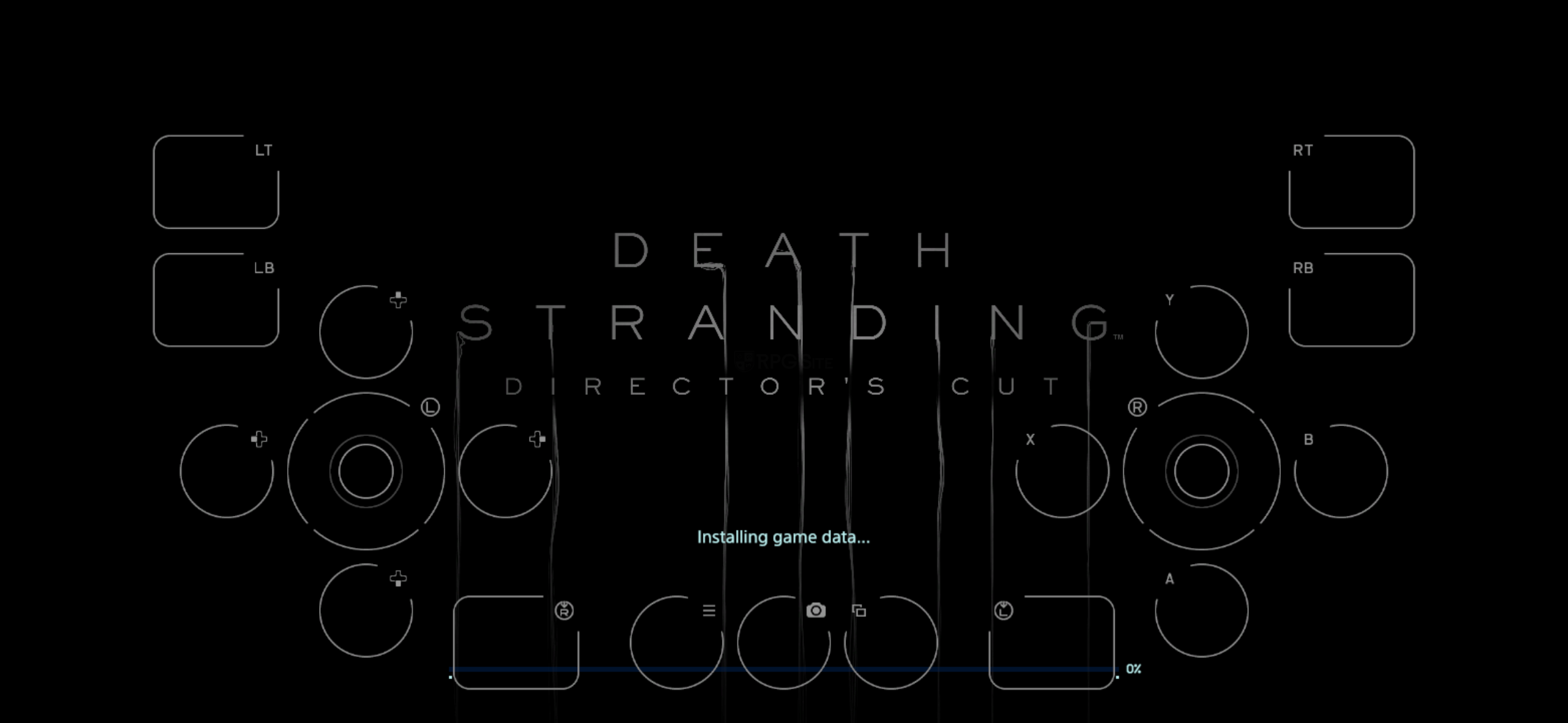
[Editor's Note: I sent Brian a screenshot from Death Stranding Director's Cut to show how the on-screen touch controls look here.]
Brian Bucklew: Yeah, exactly like this. I think you could take the current gamepad layout and with a few changes basically just make it work on the phone if you held it like this, right? Hey, who knows? Maybe in two years that's what we will do because it actually is impossible to make it play in portrait (orientation), but I think our current designs are looking very promising. We'll see. We're in the process and finding out right now.
RPG Site: Going back to the Switch port since that's the newest launch for the team. Has the launch exceeded expectations for the team?
Brian Bucklew: Certainly. We charted on physical plus digital for almost a month on the eShop which is incredible. Way in excess of any expectations we had. I think a lot of people, including us, didn't know if there was a market for a hugely crunchy turn-based RPG like this on Switch, but there is, right? There's 160 million units or something of the Switch. That's everybody, right? So, even a tiny fraction of that is still quite a lot of players so I think that's exciting to me.
RPG Site: I think it's a perfect match for the platform. Qud is a game you pick up and play, and there is a massive portion of players who don't own PC handhelds. Qud on Switch is essentially the only way to play it portably for them right now.
Brian Bucklew: Oh, this is the first time it's a real video game. All of my friends and family who have been like, "Yeah, yeah, you make video games or whatever, right?" Like after 20 years, it's on Nintendo Switch, and they're like, "Oh, wow! You made a video game. That's incredible." Nintendo is, for most people, real video games and everything else is just toy stuff, right? Not real in the same kind of way that being on a Nintendo system is.
RPG Site: Since you can't tell Qud's story in a book, have you considered doing a proper lore book or merchandise like that?
Brian Bucklew: I think we've considered a few things. It was originally a tabletop game. We've obviously thought about some kind of supplement for tabletop role-playing games, but we don't have anything in production right now. It's something we would consider.
Obviously the writing in the world is something we really love. I think at least a couple people on the team would really like to write books, I don't know if they want to write a Qud book. I think they probably want to write other stories. We certainly have other stories to tell after 20 years that are also fun. So we'll see. We've got other merch in the works. No books, but some other fun stuff coming up.
RPG Site: So should I expect a green vinyl with ASCII lettering?
Brian Bucklew: Maybe.
RPG Site: Since we are still on the narrative, how did you get involved with Bungie's Marathon?
Brian Bucklew: We knew a few people inside the team who liked our storytelling and so we got invited in based on that, right? Them saying, "Hey, look, Marathon is a storied game, right? People love it. People love it for its lore in particular, right? It has wild, deep, incredible writing and lore associated with it. If you don't know about the history of Marathon's lore and you're interested in this kind of stuff at all as an RPG player, I beg you to go look at the old original trilogy's lore. It's just incredible.
I think a lot of people were afraid that Bungie didn't understand that Marathon was a lore-heavy game, but they actually did. Again, it is all Bungie's incredible narrative team, but we were a little part of that because they recognized, lore is super important to this game. Let's get some other people in here to talk about it.
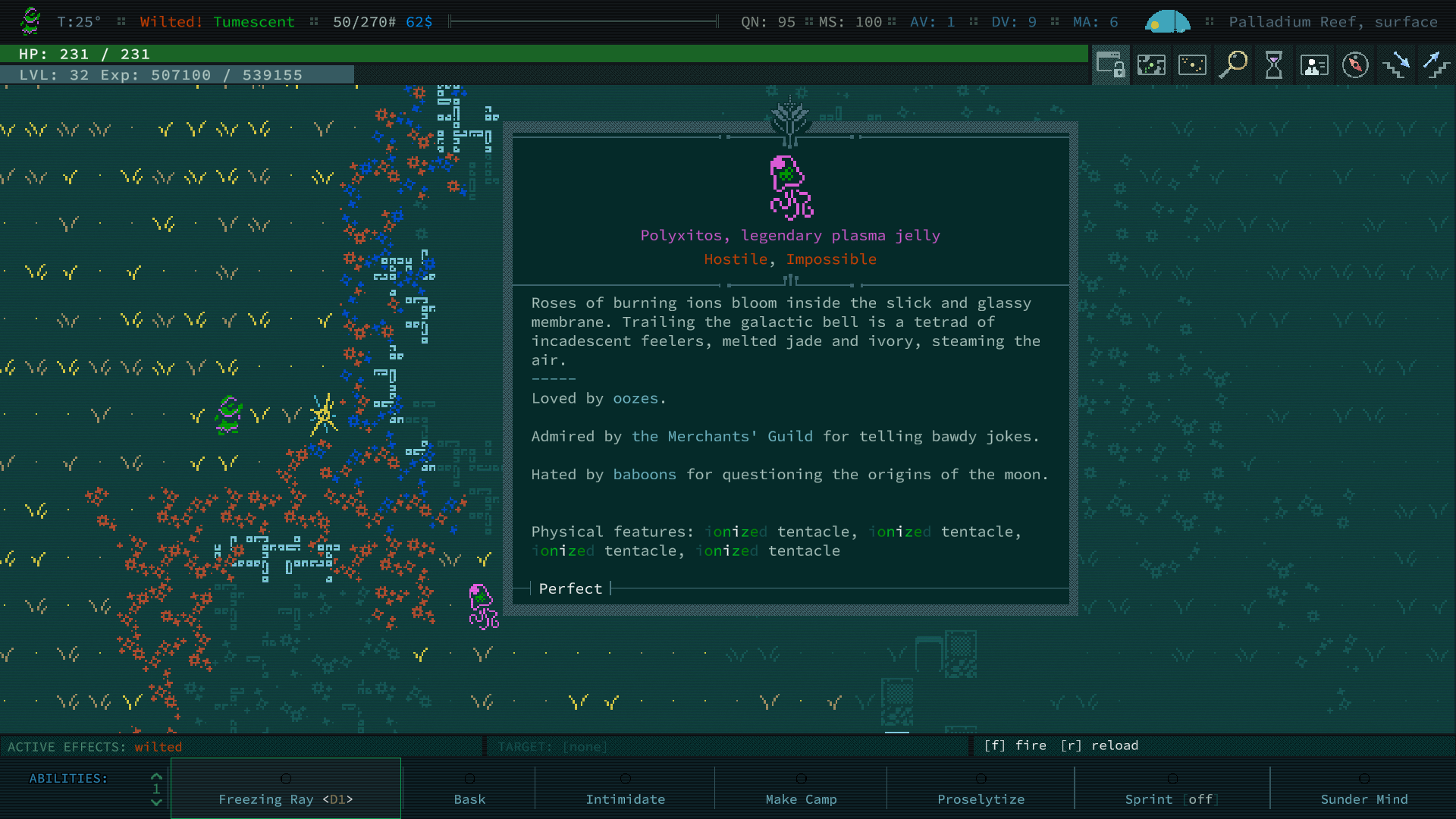
RPG Site: Caves of Qud lets you create some pretty deranged and degenerate stuff. Everyone loves that about it including myself. What is the most deranged creation you've found in Qud when people post and tag you?
Brian Bucklew: I think the most deranged thing, there are a lot of deranged things that I've seen in my time as a Caves of Qud developer, but the one that pops to mind when you say that, is a particular player, who in the lead up to 1.0, said they were crashing the game because of what they were doing, and what they were doing was engaged in extremely degenerate and deranged behavior, which I won't spoil, but it was doubling everything that they had on their body.
Every time that they performed this maneuver, they would do this thing, which every item that they were carrying, and had equipped, they would double it, and then they would pick that all up, and then they would go do the thing again. This was not simple. Each of these things took some time and they began doubling everything that they had and doubling everything they had until they had like 16 gigabytes of memory full of just arrows and and injectors and stuff, just gigabytes of limbs and swords and shields.
They said they have like 16 gigabytes of this stuff, and when they go to pick up the next copy of the pile from the corpse of myself, it's slow. It's slow. Brian, you need to fix this because it takes like three minutes to pick up 16 gigabytes worth of garbage from the ground. I said thank you. That's one of the most strange things I've ever seen anyone do, but we did make it much faster. It's now very quick.
In those circumstances, you can eventually just exceed the physical limitations of your computer, and I can't do anything about that. It's fairly quick to fail in those cases now.
Advertisement. Keep scrolling for more
RPG Site: In your opinion what is the ideal life form and can you make it in Qud?
Brian Bucklew: A perfect sphere, right? Because you no longer need proprioception, right? You know where you are at all times, right? You're an exact distance from your center, right? So you don't need to know where your hand is. You can't mess it up. So you don't need to think about that. You can't do anything ungodly as a perfect sphere, right? Your limbs are useful only for sin, right? And so I think it's clear that a perfect sphere with no ability to move is the ideal life form. You're existing in an ideal platonic state already and so there's no need to move from that. When we move from that to now, it's clearly bad, right? Only bad things are happening from that distance.
RPG Site: Who came up with the phrase 'Live and drink'?
Brian Bucklew: That was Jason for sure. One of the most axial moments, which just says so much about the culture of the game. The culture of the world. It's a beautiful sentiment that I recognize your suffering, and share my resources in order to alleviate. It's an acknowledgement of others I think underneath the covers.
RPG Site: When you first saw 'Live and drink', did you think it would become this big meme for the game and it is basically everywhere now.
Brian Bucklew: No, I think I think he came up with it very early. I'm a technically minded individual. It took me a little longer to come around to the human side of being than someone who's not a technically minded person. I kind of vaguely got it. Now I really appreciate it. So when he first said it, I don't think I really appreciated how ingenious a piece of world building it was. I think it's there that I have to give him a lot of credit for being so far ahead of me in sort of humane terms in creation many many years ago.
RPG Site: I think you both compliment each other really well based on the interviews I've seen. I recall a fantastic one I watched a little while ago on YouTube that I regret not watching sooner when I was deep into Qud. I remember thinking before then that Qud was just like Dwarf Fortress, but little did I know what I was getting into.
Brian Bucklew: That's how I feel about Caves of Qud, too. I thought I was just making a little Omega game. Little did I know what I was getting into. I do think the partnership is a really incredible one. We compliment each other very well. I think that we've both learned a lot from each other, over time, and I think moderated the worst of each of our impulses, and pressures us to bring out the best in each of us. I think, especially in running the company, anchors each of us in a way that you might otherwise kind of spin out as a sole founder, and maintainer of a game. I think just having the two of us keeps us both well anchored in the real world.
RPG Site: How has it been working with Kitfox Games and what made you want to work with an external publisher in the first place?
Brian Bucklew: We didn't need an external publisher. We could have self-published, but we were looking for a partner that would support us, and do the things we were not good at. Tanya, who is one of the leads at Kitfox, has always been really kind and generous in our time as indie devs. So, when we first sort of entered the domain of indie devs, rather than just working on it on our own, Tanya really opened a lot of doors for us. Really was just so generous, and I think that there was just a great alignment between their recent partnership with Dwarf Fortress. Dwarf Fortress, Tarn and Zach are obviously incredible. We love them personally, as well as the game. It was kind of irresistible being partnered with Kitfox, who we knew and trusted over years, and Dwarf Fortress, who obviously just stands as a unique, luminous star in the sky.
How could we turn that down? It's incredible. I feel lucky to be working with them.
RPG Site: What is your favorite game from 2025?
Brian Bucklew: I have no clue when any game came out. I think my favorite game in 2025, was probably Blue Prince, which I just found incredibly compelling for all the reasons everyone said. I really played the heck out of it and enjoyed it a lot.
RPG Site: What have you been playing recently that you've enjoyed a lot?
Brian Bucklew: I recently played the Yakuza games for the first time because I'm sort of the reverse of you. I played PC games. The last console I played was like the Dreamcast, because I just don't like 30fps and consoles were just kind of low fps for many years.
The PS5 I found really enjoyable. The games are performant, HDMI CEC means I can just hit a button on the controller and it turns on my TV and picks the input. That sounds like a small thing, but I'm incredibly lazy and so all of a sudden I could actually just sit down on the couch and turn on my PS5.
Now I've been playing all these games which I didn't play for the last 20 years. I think my favorite of those is Yakuza. It is not like I expected at all. Instead it is sort of like a very lovingly crafted history of this tiny single block with a lot of humor and real heart and I really enjoyed it. It's probably my favorite just sort of random game I've played recently.
RPG Site: Where are you in the Yakuza series now?
Brian Bucklew: I am on Yakuza 2 which is like 700 hours into the series or something, right? *laughs* Like Yakuza Zero and Yakuza 1 were both multi 100 hour games.
RPG Site: When I played Yakuza 0 for the first time, it was 2017, and I hadn't played the previous PS3 or PS2 ones. I think I spent like 40 hours on just the disco dancing mini-game. Yakuza 2 is one of my favorites as well, the Kiwami version. I absolutely love it. I assume you're playing the PS5 versions since those are 60fps now.
Brian Bucklew: Yeah. There's like Kiwami, Kiwami 2, and Kiwami 3 remakes of Yakuza, Yakuza 2, and Yakuza 3, though they got pretty bad reviews so I don't know how they compare to the originals.
RPG Site: I have not played the originals for Yakuza and Yakuza 2, but I have played 3. I treat Yakuza Kiwami as DLC for 0 because that's how it felt to me when I first played it.
Brian Bucklew: Yeah, it did feel like that.
RPG Site: Yakuza Kiwami 2 on the other hand felt like a new game compared to Kiwami. I can't wait for you to finish it.
Brian Bucklew: I think that I'll enjoy it, because at this point, I've sort of come around to just enjoying things that bug me in their own regards. Whereas maybe when I was younger, I really wanted things that felt good immediately, and so that really opened up a lot of things that weren't available to me before. Games like Grand Theft Auto. I don't really enjoy playing them.There's a lot I don't like about them, but I recently played Grand Theft Auto V, and there's a lot I don't like about it, I wouldn't have played it at the time, but now I found it to be this really interesting time capsule of a time and place, where they took a snapshot of of the world in 2015 or whatever.
If you went a hundred years from now, and someone played that, and asked you, "Is this what it was really like to be in 2015?" You would have to say basically yes. It's a little hyperbolic, but the vibes of being in this place and the texture of the music, and the look of the cars, and the sound of the people, that's basically what it was like to hang out on the street in 2015.
That's kind of an incredible artifact. So I really enjoyed just being in that artifact for a few hours in a way. I couldn't have enjoyed it at release time because it was just sort of in the present day, but at some distance, I found it to be really remarkable for that reason.
RPG Site: I think the GTA games, even if you don't like gel with the gameplay or the writing, are worth it for the effort they put into the music and curation. It is amazing.
Brian Bucklew: I mean there's obviously an incredible amount of work and passion in the thing. Nowadays, that's what I appreciate. I can appreciate the craft of the thing without vibing with the story. I can appreciate the craft of the story without being like, "Oh yeah, I really love experiencing this, right?" Getting old. I'm really appreciating that. I can go back and watch movies from 100 years ago. They're kind of unfun and grating to watch, but there's so much to love about the understanding it gives you of what's happening today, about the craft that they were creating at the time. That is all very relevant to the craft you do today.
RPG Site: What you just said reminded me of how I looked at two specific things. One of them was The Silmarillion, because I found it very difficult to get through when I first tried it many years ago. This was after watching The Lord of The Rings and having just finished that book. The first page felt more complex than the entire Lord of the Rings with names *laughs*. The second thing is The Name of The Rose, which is a book Josh Sawyer brings up a lot, and also brought up when I interviewed him. That was a pretty difficult book to read initially, but I wanted to do it instead of watching the movie. Speaking of Josh, did you play Pentiment?
Brian Bucklew: I love Pentiment. Incredible. I love all of Josh Sawyer's stuff. A real master of the art. I feel maybe a little childish for having discovered this. I feel like other people who are more connected to humanity and art, might have discovered that. You should imbibe art that isn't enjoyable, because there's stuff to learn there, but I'm glad I learned it now, eventually. I think l practically, I've still got a lot of years left, probably. I think it just takes some people longer to figure things out than other people.
Advertisement. Keep scrolling for more
RPG Site: How do you like your coffee? Go into as much detail as possible.
Brian Bucklew: I like it just a little sweet, and if I could get a good Cuban coffee, super sweet and super black in a tiny little dense cup, I might take that every day. I don't know how to make it that well. I grew up in South Florida, and people would make good Cuban coffee that I think is the best. I like it not too strong, not too flowery, and just like just a touch sweet and no cream.